A water molecule, H2O, has two hydrogen atoms joined to one oxygen atom by covalent bonds. The molecule is bent, with an angle of about 104.5° between the bonds.Oxygen is more electronegative than hydrogen, so the shared electrons are pulled towards it. The oxygen end becomes slightly negative (δ−) and the hydrogen ends slightly positive (δ+). Water is therefore a polar molecule (a dipole).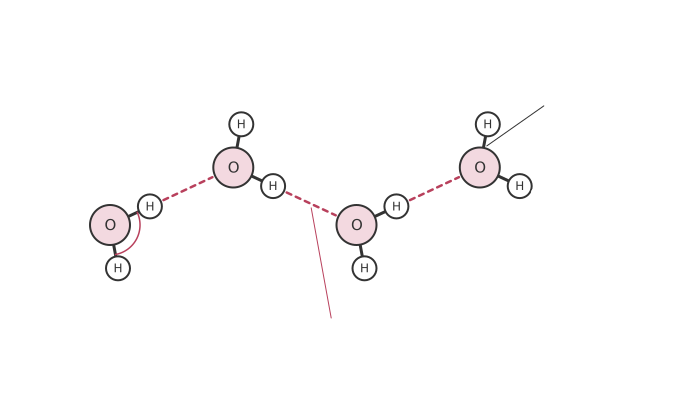
• High latent heat of vaporisation: much energy is taken from a surface when water evaporates, which gives a cooling effect (sweating, transpiration).
• Cohesion: water molecules stick together, giving a high surface tension.
• Density: water is densest at 4 °C, and ice is less dense than liquid water.Worked example: energy needed to warm 0.5 kg of water by 10 °C:E = mcΔT = 0.5 × 4200 × 10 = 21 000 J = 21 kJ The same mass of most other liquids would need far less energy.
• High latent heat of vaporisation: much energy is taken from a surface when water evaporates, which gives a cooling effect (sweating, transpiration).
• Cohesion: water molecules stick together, giving a high surface tension.
• Density: water is densest at 4 °C, and ice is less dense than liquid water.Worked example: energy needed to warm 0.5 kg of water by 10 °C: