Water is often called the universal solvent because so many substances dissolve in it. This is a direct result of water being a polar molecule.Ionic substances. When a salt such as sodium chloride is added to water, water molecules cluster around the ions. The δ− oxygen atoms are attracted to cations such as Na+, and the δ+ hydrogen atoms are attracted to anions such as Cl−. Each ion becomes surrounded by a shell of water molecules (it is hydrated), so the ions separate from the lattice and spread through the water.
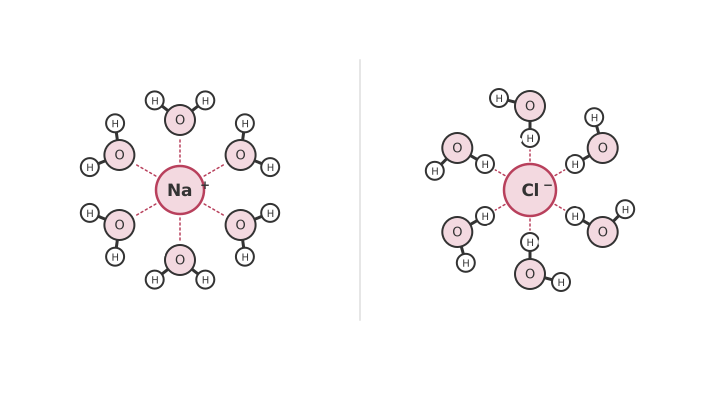
Polar molecules. Molecules with polar groups, such as the –OH groups of glucose or the charged groups of amino acids, form hydrogen bonds with water and dissolve. Such substances are described as hydrophilic.Non-polar molecules. Lipids and other molecules with long hydrocarbon chains cannot form hydrogen bonds with water, so they do not dissolve. They are hydrophobic and tend to cluster together, which is important in forming cell membranes and in folding proteins.Why it matters. Because reactants dissolve in water, the cytoplasm is where most metabolic reactions take place: dissolved molecules move about freely and collide with enzymes. Dissolved substances can also be transported, and they lower the water potential of a solution, which drives osmosis.Some important gases dissolve too. Oxygen and carbon dioxide dissolve in water, allowing gas exchange across moist surfaces such as alveoli and gills.
Water as a Polar Solvent
Read the text
Read the text and highlight anything you think is important. When you go on, the text is hidden and you answer from memory.
Specification: Edexcel Biology B (8BI0), AS-level, 1.7 Water. Topic: Chemistry for Life.
Key terms in this lesson
- colorimeter
- An instrument that measures the amount of light of a particular colour absorbed by, or transmitted through, a solution.
More in Chemistry for Life
- Covalent Bonding
- Important Anions
- Important Cations
- Water
- Water as a Transport Medium
- Water as a Habitat
- Water in Plant Transport Systems
- Water in Hydraulic Mechanisms
All 10 lessons in Chemistry for Life · All Edexcel AS-level Biology topics