 BRAINCAKE
Modelling Osmosis
Osmosis can be modelled in the laboratory using Visking tubing (dialysis tubing). This is an artificial, partially permeable membrane with tiny pores. Water molecules can pass through, but larger molecules such as sucrose cannot.
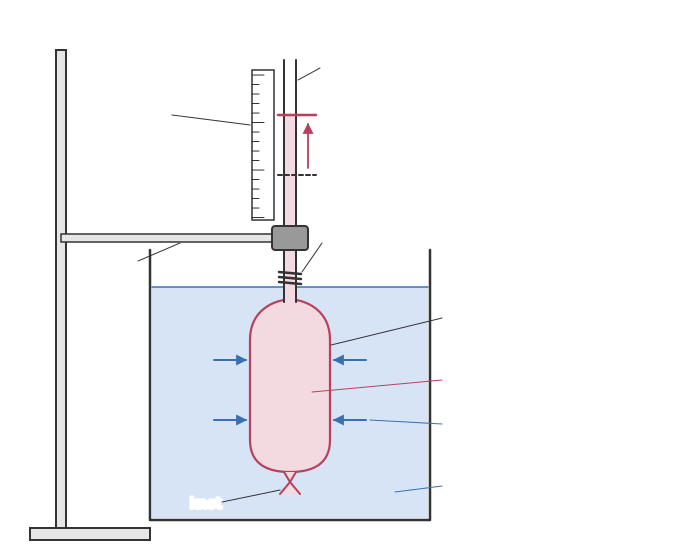
A simple osmometer is set up like this:
1. Tie one end of a length of Visking tubing and fill it with concentrated sucrose solution.
2. Fit a narrow capillary tube into the open end and seal it tightly.
3. Clamp the tubing in a beaker of distilled water and mark the starting level of liquid in the capillary tube.
Sign in free to see the rest of this lesson, the R.E.C.I.P.E. recall steps and the quiz
BrainCake is free. Make an account in seconds and pick up where this page stops.
Key terms in this lesson
- water potential
- A measure of the tendency of water molecules to move out of a solution; water moves from a higher to a lower (more negative) water potential.
More in Cell Transport Mechanisms
- Diffusion
- Facilitated Diffusion
- Water Potential ψ
- Osmosis
- Osmotic Concentrations
- Osmosis in Animal Cells
- Water Potential in Plant Cells
- Osmosis in Plant Cells
All 18 lessons in Cell Transport Mechanisms · All Edexcel AS-level Biology topics