 BRAINCAKE
Monosaccharides
Monosaccharides are the simplest carbohydrates: single sugar units that cannot be hydrolysed into smaller sugars. Their general formula is (CH2O)n, and they are named by the number of carbon atoms:
• trioses (3C), such as glyceraldehyde, made in photosynthesis and respiration
• pentoses (5C), such as ribose (in RNA and ATP) and deoxyribose (in DNA)
• hexoses (6C), such as glucose, fructose and galactose
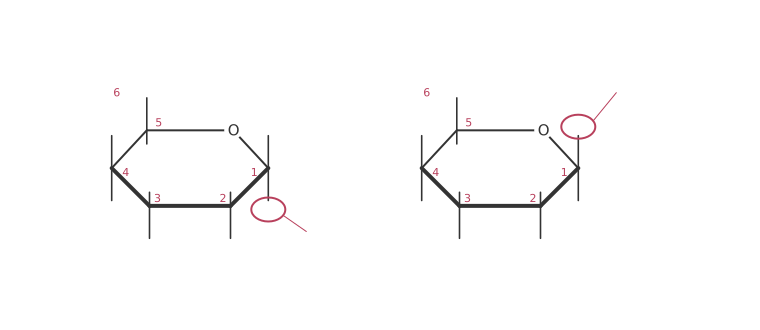
In solution, pentoses and hexoses mostly form rings. Glucose, C6H12O6, forms a six-membered ring of five carbons and one oxygen. The carbons are numbered 1 to 6, starting next to the ring oxygen.
Sign in free to see the rest of this lesson, the R.E.C.I.P.E. recall steps and the quiz
BrainCake is free. Make an account in seconds and pick up where this page stops.
Key terms in this lesson
- isomer
- One of two or more molecules with the same molecular formula but a different arrangement of atoms.
- reducing sugar
- A sugar that can donate electrons to, and so reduce, another chemical, such as the Cu2+ ions in Benedict's reagent.
More in Biological Molecules
- Organic Compounds
- Carbohydrates
- Disaccharides
- Test for Sugars
- Polysaccharides
- Starch
- Test for Starch
- Glycogen
All 25 lessons in Biological Molecules · All Edexcel AS-level Biology topics