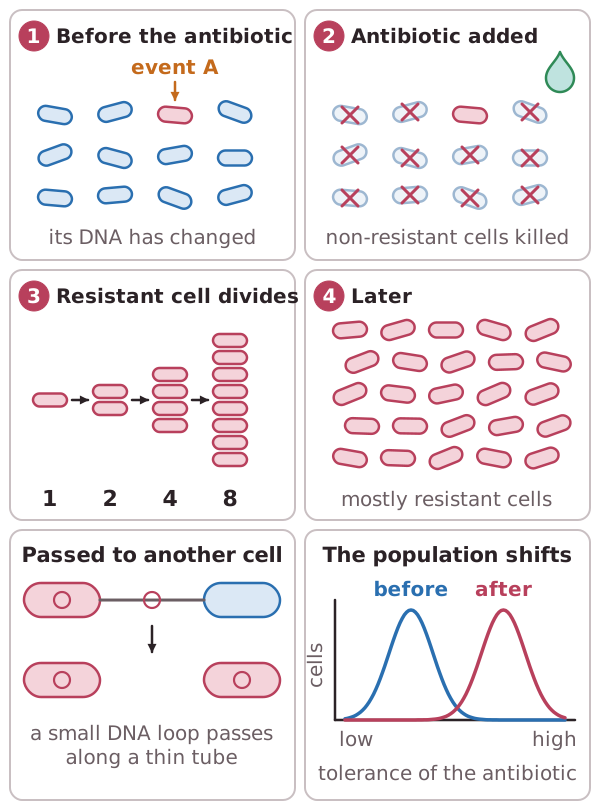
Some antibiotics such as penicillin are no longer effective against some bacteria.Populations of bacteria have developed resistance to antibiotics such as penicillin.A chance mutation within a bacterium led to the ability of the bacterium to make a new protein.The protein was a beta-lactamase enzyme with the ability to break down the beta-lactam ring in the chemical structure of penicillin. The enzyme was given the name penicillinase.The gene was on a plasmid and bacteria are able to pass plasmids on to their next generation(vertical transmission) by binary fission and to other bacteria (horizontal transmission) by a process called bacterial conjugation.The mutation would have been of no advantage to the bacterium without the use of penicillin to kill bacteria.The use of penicillin provided the selection pressure to allow any bacteria with the advantageous allele to outcompete other members of the population.Penicillin would have killed all the other members of the population but the bacteria with the allele have survived and been able to reproduce successfully passing on the advantageous allele for antibiotic resistance to their offspring and over many generations the allele frequency and the number of bacteria with the allele will have increased.This is an example of directional selection.The normal distribution curve shifts towards phenotypes at one extreme and away from phenotypes at the other extreme.