The gas exchange system of each species depends on environmental conditions, size, movement and energy consumption.Plants require carbon dioxide for photosynthesis. Oxygen produced by photosynthesis may be used in respiration and carbon dioxide produced in respiration may be used in photosynthesis. This depends on the balance of photosynthesis and respiration.In the dark when photosynthesis is not occurring, oxygen is taken up by the plant.Gas exchange in plants takes place by diffusion in air. Diffusion in air is more rapid than diffusion in water and no cell is far from the external air so there is a short diffusion path between the external air and the cells.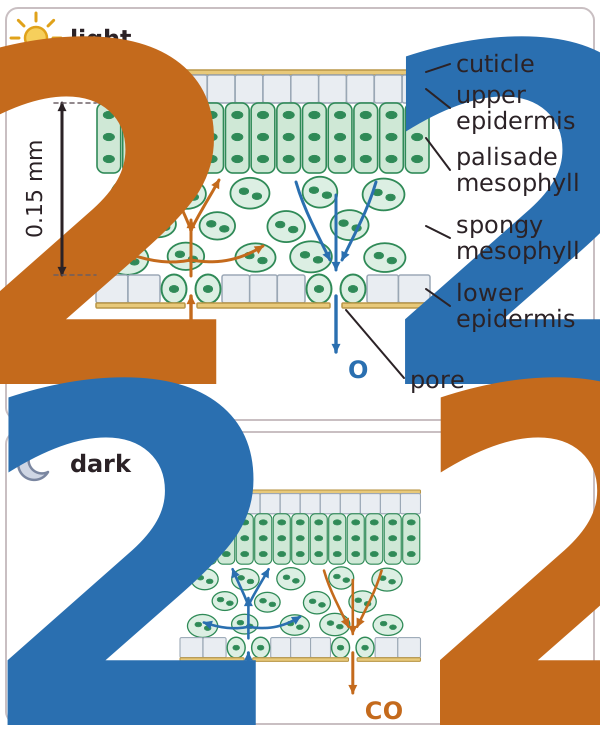 Air spaces in the leaf provide a very large surface area so that gases can rapidly come into contact with mesophyll cells. There is no mass transport system for gases. Gas exchange is by diffusion only.