Gases enter the leaf through pores called stomata.Each stoma is bordered by guard cells. Guard cells are specialised epidermal cells. They contain chloroplasts and the cellulose of their walls is thicker adjacent to the pore and less thick on the outside farthest from the pore.When turgor is low, the asymmetric thickening of the cell walls closes the pore.When carbon dioxide is required and conditions are favourable for photosynthesis solutes including potassium ions are moved into the guards cell by active transport. Water follows by osmosis from the surrounding epidermal cells. Guard cells swell, turgor pressure increases and the pore opens.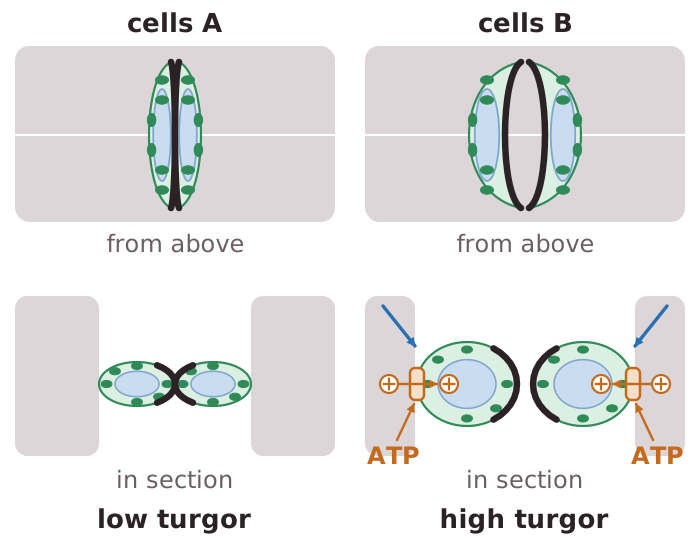 When active transport of potassium ions into cells stops and potassium ions are excreted, water leaves the guard cells by osmosis.Lenticels.In woody plants there are no stomata on the surface of the stems for gas exchange to occur. Special spongy areas made of loosely arranged cells with many air spaces called lenticel link the inner tissues to the outside world. They also form on roots so gas exchange can occur between roots and soil.