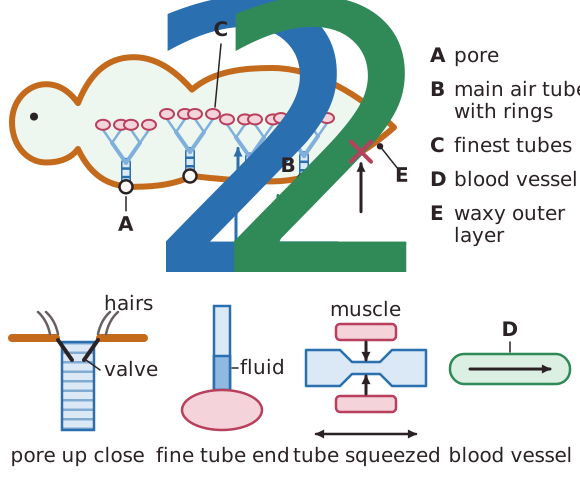
In terrestrial organisms, gas exchange systems are exposed to the environment. The need to exchange gases with the environment conflicts with the need conserve water. Organisms need to limit water loss without reducing the efficiency of their gas-exchange systems.Water evaporates from the surface of the bodies of all terrestrial organisms including insects. Insects are adapted to limiting their water loss by having a small surface area to volume ratio, a waterproof cuticle that covers their rigid chitin exoskeleton and spiracles at the openings of tracheae on the surface of the body that can be closed to reduce water loss.Gases enter and leave through tiny pores called spiracles. These can be closed by a valve to reduce water loss. Much of the time insects keep their spiracles closed to prevent water loss. Periodically, the valve opens the spiracles to allow gas exchange.The ends of the tracheoles are filled with water so the final diffusion pathway is in water. This reduces the amount of evaporation from the tracheoles.