Reducing Water Loss
Gases enter and leave through tiny pores called spiracles. These can be closed by a valve to reduce water loss. Much of the time insects keep their spiracles closed to prevent water loss. Periodically, the valve opens the spiracles to allow gas exchange.Diffusion Distance
Most systems of gas transport are able to supply enough oxygen to the tissues and remove the carbon dioxide produced by respiration in spite of great distances between the environment and the individual cells of the tissues by using a combination of mass transport and diffusion.The open circulatory system of insects means no transport medium is needed to bring oxygen to the cells as the cells are in direct contact with atmospheric oxygen. The disadvantage of the tracheal system is that it occupies a large fraction of body volume and the walls of the tracheoles must be thin to reduce the diffusion distance. The thin walls would not be able to withstand the high hydrostatic pressures needed in large organisms. This limits the size of insects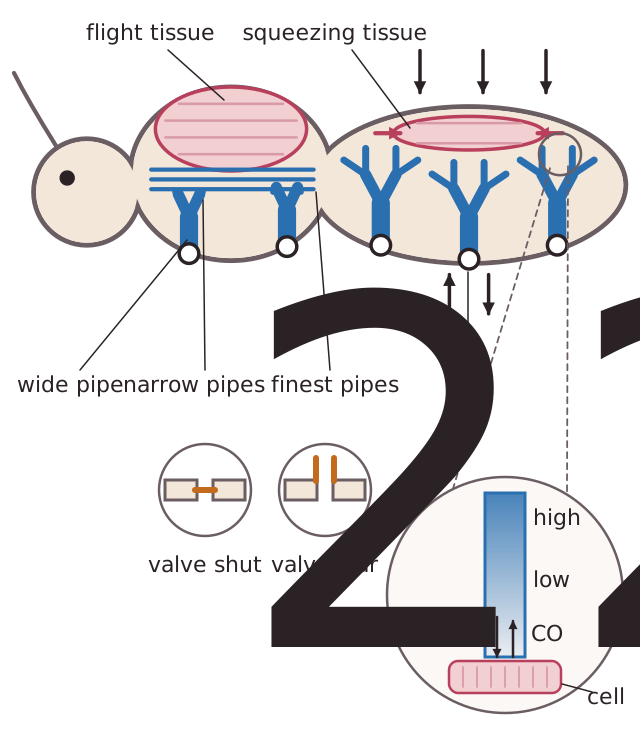
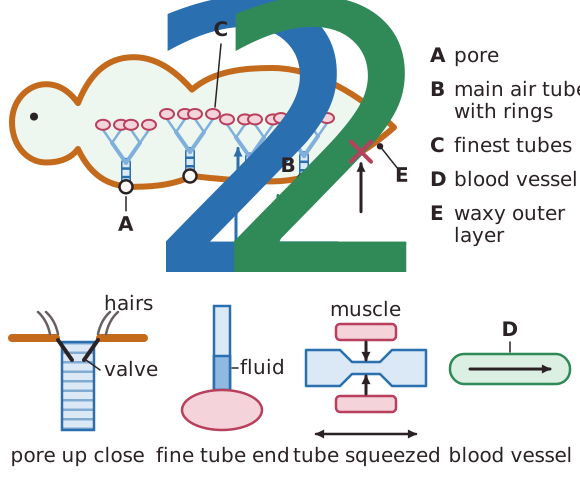
Gases enter and leave through tiny pores called spiracles. These can be closed by a valve to reduce water loss. Much of the time insects keep their spiracles closed to prevent water loss. Periodically, the valve opens the spiracles to allow gas exchange.Diffusion Distance
Most systems of gas transport are able to supply enough oxygen to the tissues and remove the carbon dioxide produced by respiration in spite of great distances between the environment and the individual cells of the tissues by using a combination of mass transport and diffusion.The open circulatory system of insects means no transport medium is needed to bring oxygen to the cells as the cells are in direct contact with atmospheric oxygen. The disadvantage of the tracheal system is that it occupies a large fraction of body volume and the walls of the tracheoles must be thin to reduce the diffusion distance. The thin walls would not be able to withstand the high hydrostatic pressures needed in large organisms. This limits the size of insects