All gas exchange systems must supply oxygen to respiring tissues and remove carbon dioxide produced by respiration rapidly enough.In fish the distance between the environment and the individual cells of the tissues is relatively short.Mass transport achieves efficient transport of gas over large distances, requires energy and does not occur across tissue barriers. Diffusion achieves gas transport across barriers.In fish, where blood and water flow past each other so diffusion of gases takes place between the blood and the surrounding water, the directions which they flow past each other (e.g. countercurrent or concurrent) determine the efficiency of gas exchange as it contributes to the maintenance of the diffusion gradient.The gills of fishes provide short diffusion distances, in a protected space so can be very thin, and the problem of water loss does not exist.The flows of blood and water occur in opposite direction (countercurrent flow) and much oxygen can be extracted from the surrounding water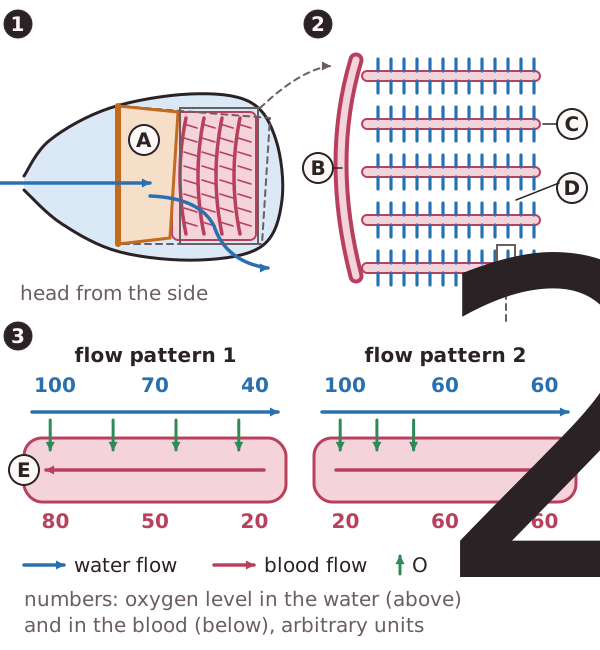 This is important because water contains little oxygen compared to air and, to compensate this, much energy is expended to maintain a high flow rate of water through the gills.