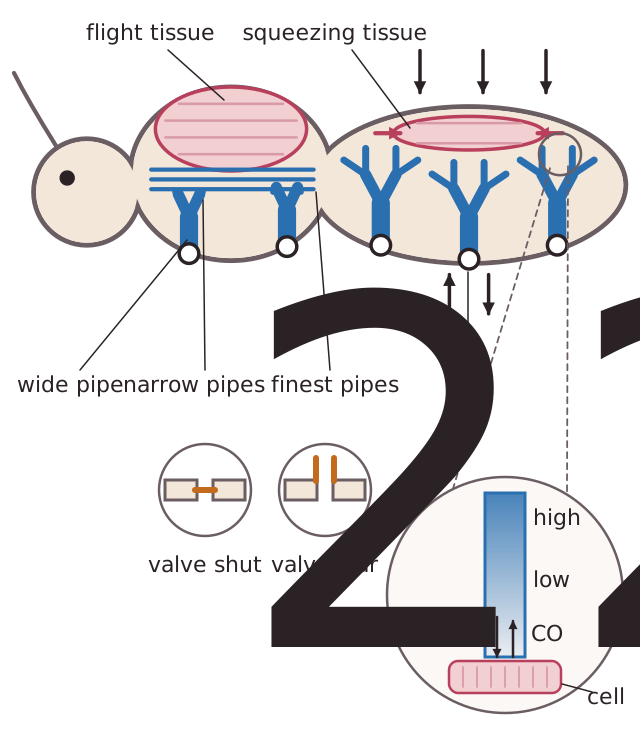
Most tracheoles extend parallel to the muscle fibres. The high tracheolar densities and penetration of flight muscle cells by tracheoles allow flying insects to achieve high oxygen consumption rates.The maximum partial pressure gradient available to drive the diffusion of oxygen to the cells is fixed by the atmospheric partial pressure of oxygen.However flushing air through the tracheae by active muscular movements of the body, coordinated with the opening and closing of the spiracles can increase the pressure in the tracheoles.The contraction of muscles squeezes the trachea enabling mass flow of air in and out of the trachea.
Mass Transport
Read the text
Read the text and highlight anything you think is important. When you go on, the text is hidden and you answer from memory.
Specification: AQA Biology (7401), AS-level, 3.3.2 Gas exchange. Topic: Exchange of Gases.
Key terms in this lesson
- diffusion
- The net passive movement of molecules or ions from a region of higher concentration to a region of lower concentration, down a concentration gradient.
- spiracle
- A pore in the exoskeleton of an insect, opened and closed by a valve, through which air enters and leaves the tracheal system.
More in Exchange of Gases
- Features of A Specialised Exchange Surface
- Gas Exchange in Unicellular Organisms
- Gas Exchange in Insects
- Diffusion Gradient
- Increasing the Rate of Diffusion
- Limitations of the Tracheal System
- Gas Exchange in Fish
- Structure of the Gills
All 28 lessons in Exchange of Gases · All AQA AS-level Biology topics