The resolution of a microscope is the ability to see two individual objects that are close together as separate entities and determines the amount of detail that can be seen.Magnification produces a large image but does not increase the amount of detail.When two objects are close to each other light reflecting off the objects diffract (spread out). If the light diffracted from each object overlaps the objects no longer appear as two separate entities and less detail can be seen.The resolution depends on the wavelength of the light or radiation being used to view the specimen.Two objects must be at least half the wavelength of light (200nm) apart to be resolved (seen as separate objects).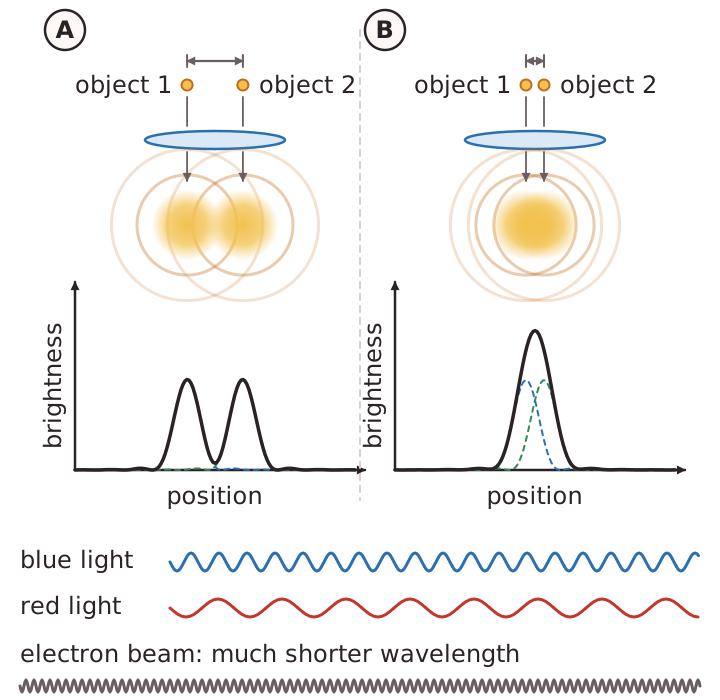 In order to increase the resolution electron microscopes can be used.