 BRAINCAKE
Cell Fractionation
Cell fractionation is the process of isolating large numbers of individual organelles to study their function.
The tissue is placed in cold buffer solution. The buffer solution has the same water potential as the cells so that the cells are not damaged by osmosis.
Sign in free to see the rest of this lesson, the R.E.C.I.P.E. recall steps and the quiz
BrainCake is free. Make an account in seconds and pick up where this page stops.
Key terms in this lesson
- ultracentrifugation
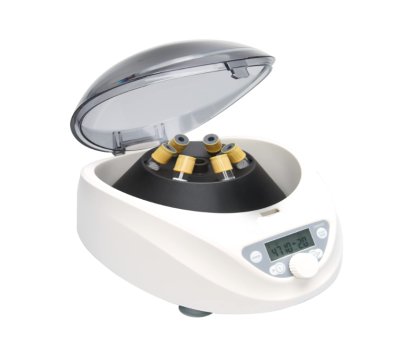
- The process of spinning a cell homogenate in a centrifuge at increasing speeds to separate organelles by size and density.
- osmosis
- The net movement of water molecules from a region of higher water potential to a region of lower water potential through a selectively permeable membrane.
- water potential
- The pressure created by water molecules, a measure of the tendency of water to move out of a solution; pure water has a water potential of zero and solutes make it more negative.
More in Cell Structure
- Magnification
- Resolution
- Ultracentrifugation
- Light Microscope
- Measuring Cells
- Electron Microscope
- Transmission Electron Microscope
- Scanning Electron Microscope
All 26 lessons in Cell Structure · All AQA AS-level Biology topics