Monosaccharides such as glucose, fructose and galactose can donate electrons to other compounds.Molecules that can donate electrons are called reducing agents.Benedict's reagent is an alkaline solution of copper(II) sulfate. Copper(II) sulfate can be reduced to insoluble copper(I) oxide which has an orange-red colour.2cm3 of the sample to be tested is added to a test tube. 2cm3 of Benedicts is added and the mixture is boiled in a water bath for 5 minutes.If reducing sugar is present an orange-red precipitate is formed.
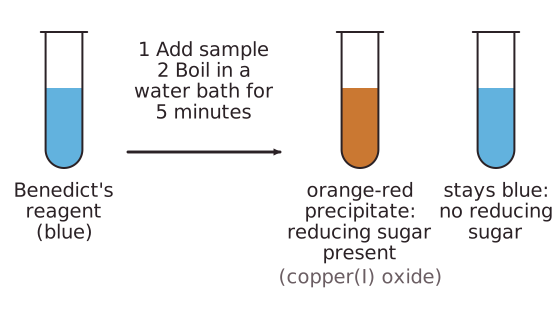
Test for Reducing Sugars
Read the text
Read the text and highlight anything you think is important. When you go on, the text is hidden and you answer from memory.
Specification: AQA Biology (7401), AS-level, 3.1.2 Carbohydrates. Topic: Biological Molecules.
Key terms in this lesson
- monosaccharide
- The monomer from which larger carbohydrates are made, a simple sugar such as glucose.
More in Biological Molecules
- Condensation and Hydrolysis
- Organic Compounds
- Carbohydrates
- Monosaccharides
- Disaccharides
- Test for Non-reducing Sugars
- Polysaccharides
- Starch
All 29 lessons in Biological Molecules · All AQA AS-level Biology topics