A condensation reaction is a reaction that joins two molecules together with a covalent bond formed by removing a small molecule such as a water molecule.Condensation polymers are polymers formed by linking monomers with condensation reactions.Examples are polypeptides and polysaccharides.Hydrolysis is the process by which a covalent bond is broken by the addition of a water molecule. 
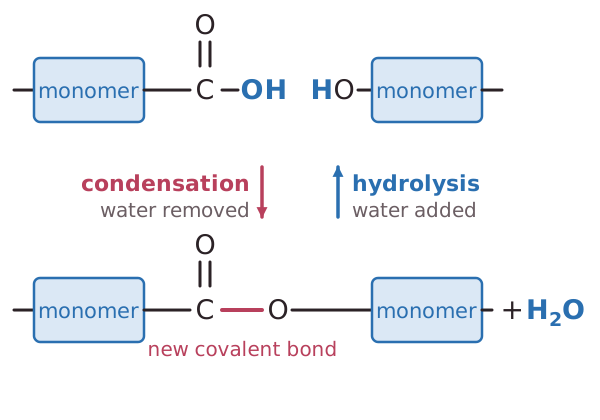
Condensation and Hydrolysis
Read the text
Read the text and highlight anything you think is important. When you go on, the text is hidden and you answer from memory.
Specification: AQA Biology (7401), AS-level, 3.1.1 Monomers and polymers. Topic: Biological Molecules.
Key terms in this lesson
- covalent bond
- A strong chemical bond formed when a pair of electrons is shared between two atoms.
- polymer
- A large molecule made of many repeating monomer units joined together by covalent bonds.
- monomer
- A small molecule that is a repeating subunit from which larger molecules such as polymers are made.
- polysaccharide
- A polymer formed from many monosaccharides joined together by glycosidic bonds.
More in Biological Molecules
- Bonding
- Polymers and Macromolecules
- Organic Compounds
- Carbohydrates
- Monosaccharides
- Test for Reducing Sugars
- Disaccharides
- Test for Non-reducing Sugars
All 29 lessons in Biological Molecules · All AQA AS-level Biology topics