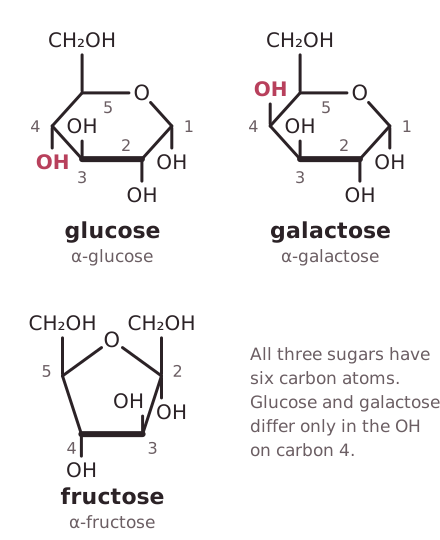
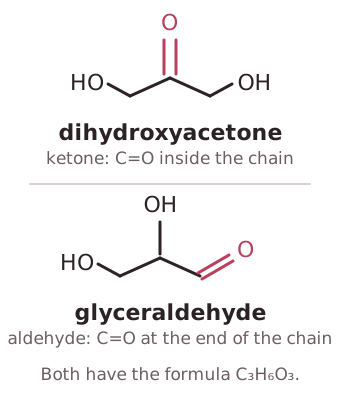
Monosaccharides are simple carbohydrates called sugars. They have a general formula of Cn(H2O)n. They are sweet-tasting substances which are soluble in water.Each molecule may have more than one isomer.Isomers are molecules with the same molecular formula but different structural or spatial arrangements of their molecules.Monosaccharides with three carbon atoms are called triose sugars. An example is glyceraldehyde, an intermediate compound in respiration and photosynthesis.
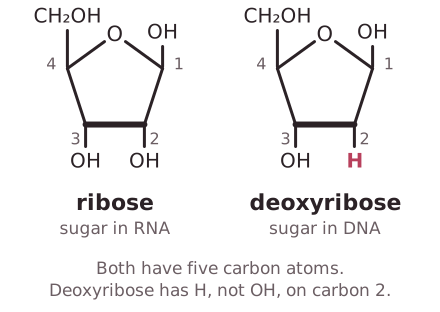
Monosaccharides with five carbon atoms are called pentose sugars. Examples are ribose and deoxyribose found in RNA and DNA.
Monosaccharides with six carbon atoms are called hexose sugars. Examples are glucose, fructose and galactose.
Monosaccharides
Read the text
Read the text and highlight anything you think is important. When you go on, the text is hidden and you answer from memory.
Specification: AQA Biology (7401), AS-level, 3.1.2 Carbohydrates. Topic: Biological Molecules.
More in Biological Molecules
- Polymers and Macromolecules
- Condensation and Hydrolysis
- Organic Compounds
- Carbohydrates
- Test for Reducing Sugars
- Disaccharides
- Test for Non-reducing Sugars
- Polysaccharides
All 29 lessons in Biological Molecules · All AQA AS-level Biology topics