The hierarchical classification system is based on supposed evolutionary lines of descent.This supposed evolutionary relationship is known as phylogeny and can be represented by a phylogenetic tree.The oldest species is found at base of tree, the most recent species are at the end of the branches and lines meet at common ancestors.Phylogenetics uses genetics to study evolutionary history starting with a hypothetical common ancestor.The tips of a phylogenetic tree can be living taxa or fossils, which represent the present time or end of an evolutionary lineage.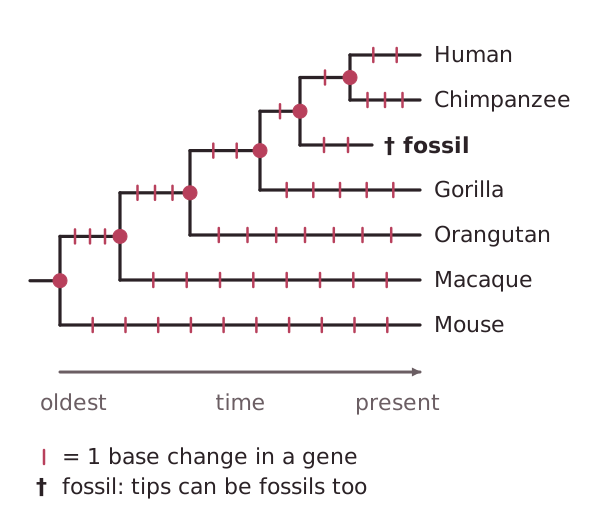 Phylogenetic trees represent relationships among genes or individual organisms. Such uses have become central to understanding biodiversity, evolution, ecology, and genomes.Computation can be used to determine the evolutionary distance between species. Sampling more genes per taxon leads to higher accuracy.