Biodiversity is the term used to describe the variety of living organisms and the variety of ecosystems in a particular area.Species richness is the number of different species in a particular area at a given time.Species diversity refers to the number of different species and the number of individuals of that species within a community.Genetic diversity refers to the number of different alleles of genes within a population.Ecosystem diversity refers to the number of different habitats.The species diversity gives an indication of the total number of species and the total number of individuals of each species in a particular habitat. The index of diversity is calculated as follows:
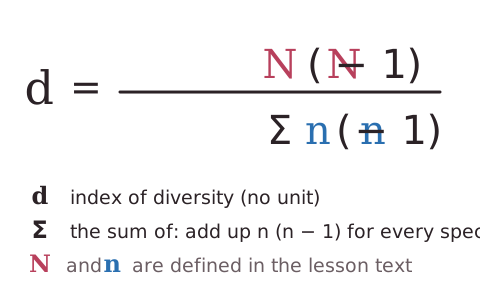
d = index of diversityN = total number of all speciesn = total number of each individual speciesΣ = the sum of
Index of Diversity
Read the text
Read the text and highlight anything you think is important. When you go on, the text is hidden and you answer from memory.
Specification: AQA Biology (7401), AS-level, 3.4.6 Biodiversity within a community. Topic: Biodiversity.
Key terms in this lesson
- gene
- A length of DNA that codes for a polypeptide or a functional RNA molecule, at a specific locus on a chromosome.
- species
- A group of organisms with similar characteristics that can interbreed to produce fertile offspring.
More in Biodiversity
- Taxonomy
- Domain
- Kingdoms
- Phylogeny
- Example Index of Diversity
- Species Diversity and Ecosystems
- The Impact of Agriculture
- Balancing Conservation and Farming
All 33 lessons in Biodiversity · All AQA AS-level Biology topics