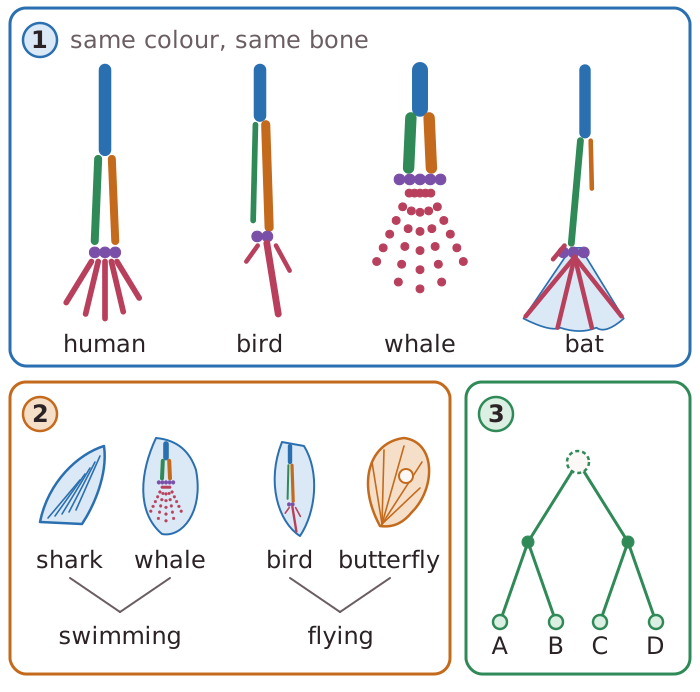
The grouping of organisms is known as classification.The theory and practice of biological classification is called taxonomy.Artificial classification groups organisms according to features such as colour, size, number of legs, leaf shape. These analogous characteristics have the same function but do not have same evolutionary origins. An example of this is fins in sharks and whales or wings in birds and butterflies.Phylogenetic classification is based on evolutionary relationships between organisms and their ancestors and homologous characteristics which have similar genetic origins e.g. the wing of the bird and the arm of a human.