When the potassium voltage-gated channels open, lots of potassium ions diffuse out of the axon down their electrochemical gradient.This causes the inside of the axon to become more negative than the resting potential i.e. the membrane becomes hyperpolarised. The potassium voltage-gated channels then close and the sodium-potassium pump restores the membrane to its resting potential.
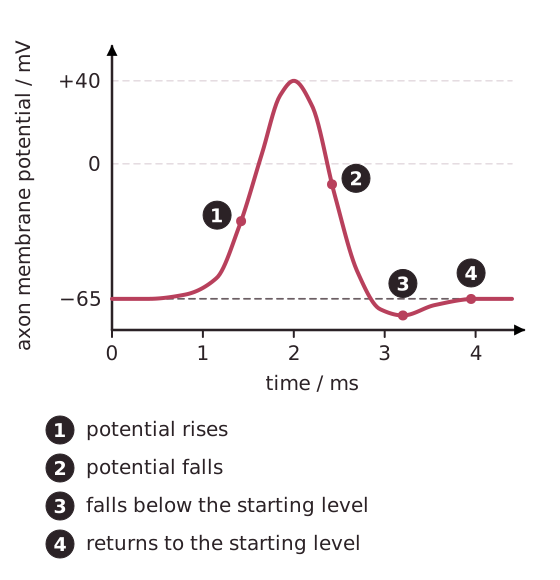
Hyperpolarisation
Read the text
Read the text and highlight anything you think is important. When you go on, the text is hidden and you answer from memory.
Specification: OCR Biology A (H420), A-level, 5.1.3 Neuronal communication. Topic: Neuronal Communication.
Key terms in this lesson
- Action potential
- The temporary reversal of the electrical charge across an axon membrane, from about -70mV to +40mV, that occurs when a neurone is stimulated above threshold.
- Resting potential
- The difference in electrical charge across an axon membrane (about -70mV, inside negative relative to outside) when a neurone is not conducting an impulse.
- Myosin
- A thick protein filament in a myofibril with globular heads that bind to actin and pull it during muscle contraction.
- Sarcolemma
- The specialised cell surface membrane of a muscle fibre.
- ATP
- Adenosine triphosphate, the universal energy currency of cells, which releases energy for cellular reactions when hydrolysed to ADP and inorganic phosphate.
More in Neuronal Communication
- Generator Potential
- Resting Potential
- Depolarisation
- Repolarisation
- The Action Potential
- Nerve Impulse
- Saltatory Conduction
- Synapses
All 38 lessons in Neuronal Communication · All OCR A-level Biology topics