Skip to content

Resting Potential

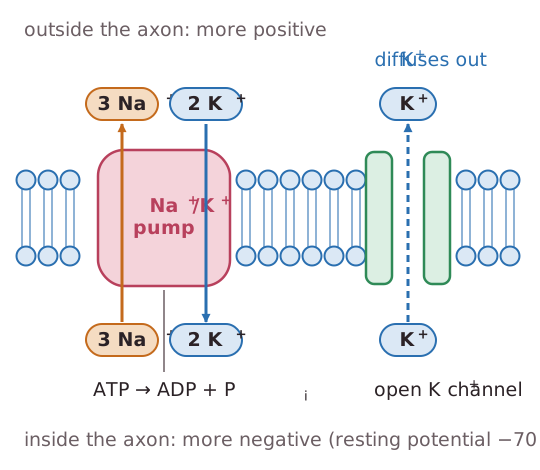
Normally, a neurone is not transmitting an impulse and the membrane is at a resting potential of -70mV. The inside of the membrane is more negative than the outside and the membrane is said to be polarised.Sodium ions are actively transported out of the axon and potassium ions actively transported in by the sodium potassium pump. For every three sodium ions pumped out, two potassium ions are pumped in.In addition, the membrane is more permeable to potassium ions. Potassium ions diffuse back out down their concentration gradient.
Read the text

Read the text and highlight anything you think is important. When you go on, the text is hidden and you answer from memory.

Specification: OCR Biology A (H420), A-level, 5.1.3 Neuronal communication. Topic: Neuronal Communication.

Key terms in this lesson

Depolarisation
A change in the potential difference across a membrane that makes the inside less negative, caused by an influx of sodium ions.
Actin
A thin protein filament in a myofibril that, together with myosin, slides during muscle contraction.
Myosin
A thick protein filament in a myofibril with globular heads that bind to actin and pull it during muscle contraction.
Troponin
A globular protein complex bound to tropomyosin that binds calcium ions, causing tropomyosin to move and expose the myosin-binding sites on actin.
Sarcolemma
The specialised cell surface membrane of a muscle fibre.

More in Neuronal Communication

All 38 lessons in Neuronal Communication · All OCR A-level Biology topics