 BRAINCAKE
Nerve Impulse
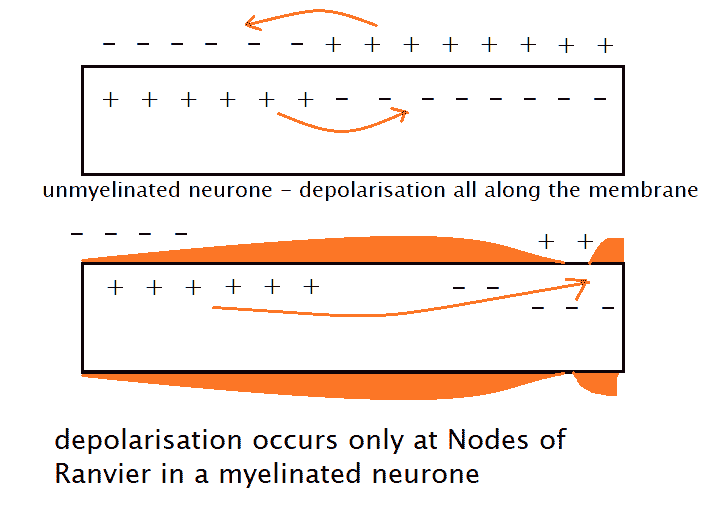
A nerve impulse is an action potential that starts at one end of the neurone and is propagated along the axon to the other end of the neurone. When a region of the membrane is depolarised, the sodium ions that have entered the cell are attracted to the negatively charged area further along the axon and diffuse sideways, triggering the depolarisation of the membrane.
Sign in free to see the rest of this lesson, the R.E.C.I.P.E. recall steps and the quiz
BrainCake is free. Make an account in seconds and pick up where this page stops.
Key terms in this lesson
- Neurone
- A specialised nerve cell adapted to transmit electrical impulses (nerve impulses) around the body.
- Action potential
- The temporary reversal of the electrical charge across an axon membrane, from about -70mV to +40mV, that occurs when a neurone is stimulated above threshold.
- Depolarisation
- A change in the potential difference across a membrane that makes the inside less negative, caused by an influx of sodium ions.
More in Neuronal Communication
- Depolarisation
- Repolarisation
- Hyperpolarisation
- The Action Potential
- Saltatory Conduction
- Synapses
- Neurotransmitters
- Transmission of Impulse across Synapse
All 38 lessons in Neuronal Communication · All OCR A-level Biology topics