Heart muscle is myogenic: the sinoatrial node (SAN) generates impulses without any nervous stimulation. However, the rate at which the SAN fires is adjusted by the cardiovascular centre in the medulla oblongata of the brain, so that heart rate matches the body's needs.The cardiovascular centre is part of the autonomic nervous system, so it works without conscious thought. It has one part that increases heart rate and one that decreases it, and both connect to the SAN.• To increase heart rate, impulses are sent along a sympathetic neurone, the accelerator nerve. Its endings release the neurotransmitter noradrenaline at the SAN, which increases the frequency of excitation.
• To decrease heart rate, impulses are sent along a parasympathetic neurone, the vagus nerve. Its endings release acetylcholine at the SAN, which reduces the frequency of excitation.At rest, impulses along the vagus nerve dominate, keeping heart rate below the rate the SAN would produce on its own.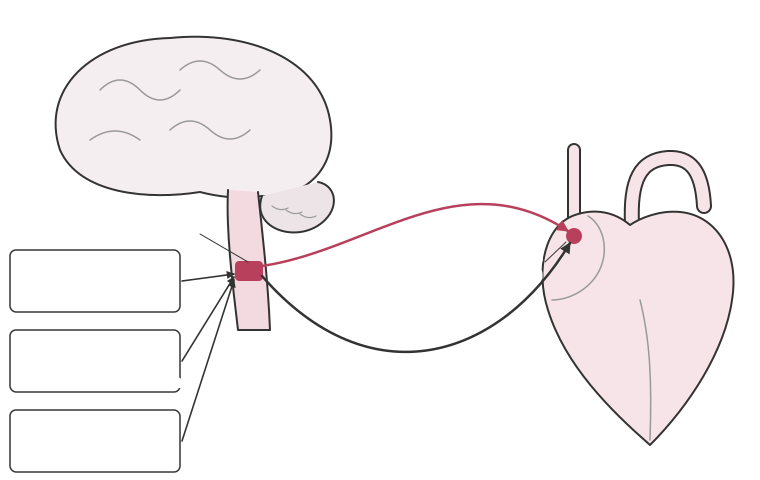
• baroreceptors, which detect changes in blood pressure
• chemoreceptors, which detect changes in blood pH, caused mainly by changes in carbon dioxide concentration
• stretch receptors in muscles, which detect movement at the start of exercise.It integrates this information and changes the balance of impulses sent along the two nerves. It changes only the rate at which the SAN fires; the heartbeat itself would continue without it. This is why a transplanted heart, which has no nerve connections, still beats.
• To decrease heart rate, impulses are sent along a parasympathetic neurone, the vagus nerve. Its endings release acetylcholine at the SAN, which reduces the frequency of excitation.At rest, impulses along the vagus nerve dominate, keeping heart rate below the rate the SAN would produce on its own.
• baroreceptors, which detect changes in blood pressure
• chemoreceptors, which detect changes in blood pH, caused mainly by changes in carbon dioxide concentration
• stretch receptors in muscles, which detect movement at the start of exercise.It integrates this information and changes the balance of impulses sent along the two nerves. It changes only the rate at which the SAN fires; the heartbeat itself would continue without it. This is why a transplanted heart, which has no nerve connections, still beats.