Baroreceptors are pressure receptors that detect changes in blood pressure. They are found in the walls of the aorta (aortic arch), the carotid arteries (carotid sinus) and the vena cava. They are stretch receptors: when blood pressure rises the artery wall stretches more and the baroreceptors send impulses to the cardiovascular centre in the medulla oblongata more frequently.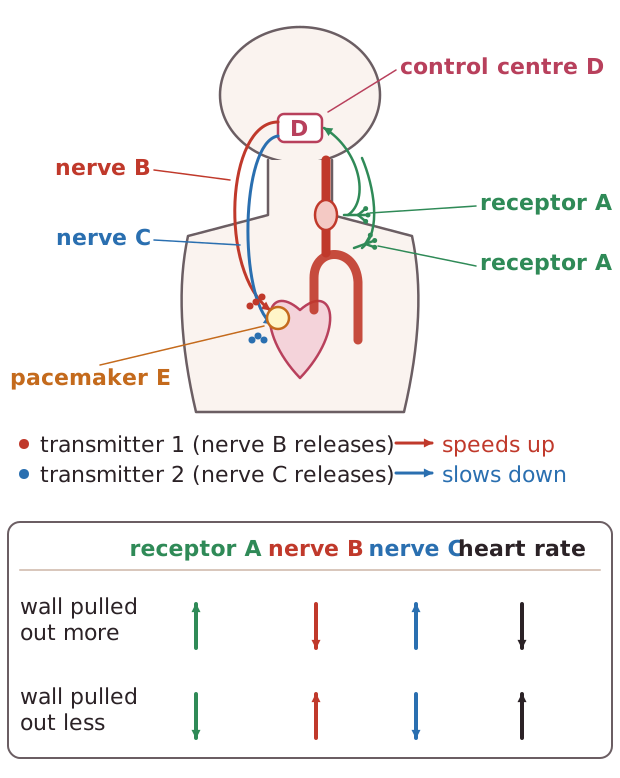 If blood pressure rises, the cardiovascular centre sends more impulses along the vagus nerve (parasympathetic) to the sinoatrial node (SAN). The nerve endings release acetylcholine, which binds to receptors on the SAN and reduces its frequency of excitation. Heart rate falls, so blood pressure returns towards normal.If blood pressure falls, the cardiovascular centre sends more impulses along the accelerator nerve (sympathetic) to the SAN. These nerve endings release noradrenaline, which increases the frequency of excitation of the SAN. Heart rate rises and blood pressure increases back towards normal.This is an example of negative feedback: a change in blood pressure triggers a response that reverses the change. It works through the autonomic nervous system, so it is involuntary and fast.