In haemodialysis, blood is taken from an artery (often through a fistula joining an artery to a vein in the arm) and passed through a machine that contains a dialysis membrane and dialysis fluid. Heparin, an anticoagulation agent, is added to the blood. The blood is then returned to the body making sure that any bubbles are removed and do not enter the body.Haemodialysis is usually carried out about three times a week for several hours at home or in a clinic.
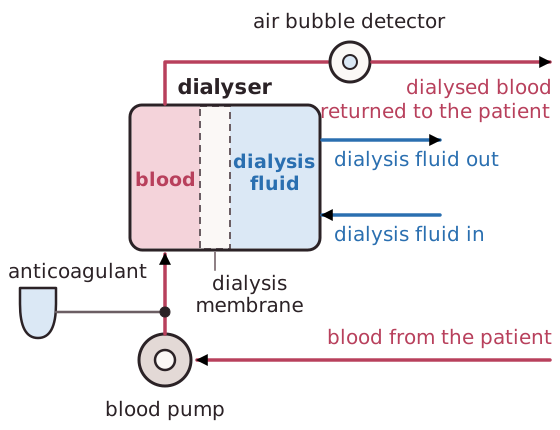
Haemodialysis
Read the text
Read the text and highlight anything you think is important. When you go on, the text is hidden and you answer from memory.
Specification: OCR Biology A (H420), A-level, 5.1.2 Excretion as an example of homeostatic control. Topic: Homeostasis.
Key terms in this lesson
- Neurone
- A specialised nerve cell adapted to transmit electrical impulses (nerve impulses) around the body.
- Effector
- A muscle or gland that brings about a response to a stimulus.
More in Homeostasis
- Countercurrent Multiplier
- Ultrafiltration, Selective Reabsorption and Osmoregulation.
- Distal Tubule and Collecting Duct
- ADH
- Kidney failure
- Peritoneal Dialysis
- Pregnancy Testing
- Anabolic Steroids
All 33 lessons in Homeostasis · All OCR A-level Biology topics