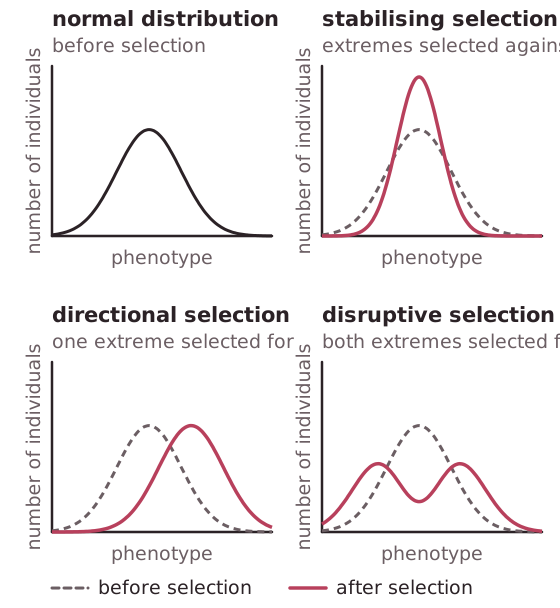
Variation within organisms follows a normal distribution or bell-shaped curve.Stabilising selection is when selection pressures reduce the survival of individuals at the extreme. Low birth weight babies and very large babies are less likely to survive so the allele frequencies at the extremes is reduced. Directional selection occurs when one of the extremes are selected for and the norm is negatively selected. An example is dark coloured peppered moths being camouflaged against dark soot covered trees during the industrial revolution. The smoke also killed the lichens so the light coloured moths were susceptible to predation as they were more visible. Disruptive selection selects for both extremes and against the mean or norm.