All the genes in a population at a given time is known as the gene pool. Over time the frequency of an allele in a population changes in response to a changing environment. The allele frequency can be calculated by simple formulae and the application of the Hardy-Weinberg PrincipleThe Hardy-Weinberg Principle states that in a stable population of diploid organisms with no disturbing factors, the allele frequencies will remain constant from one generation to the next.This assumes an isolated population with no migration, random mating and no selection pressures.
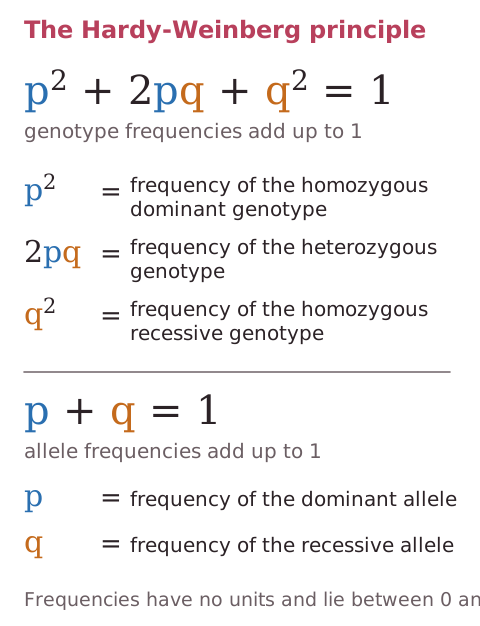
The Hardy-Weinberg Principle
Read the text
Read the text and highlight anything you think is important. When you go on, the text is hidden and you answer from memory.
Specification: OCR Biology A (H420), A-level, 6.1.2 Patterns of inheritance. Topic: Genetics and Variation.
Key terms in this lesson
- Allele
- One of the different forms of a gene, arising from mutation, that occupies the same locus on homologous chromosomes.
More in Genetics and Variation
- Dihybrid Crosses
- Linkage
- Χ-squared Test
- Epistasis
- Changes in Allele Frequencies
- Population Bottlenecks and The Founder Effect
- Types of Selection
- Species
All 41 lessons in Genetics and Variation · All OCR A-level Biology topics