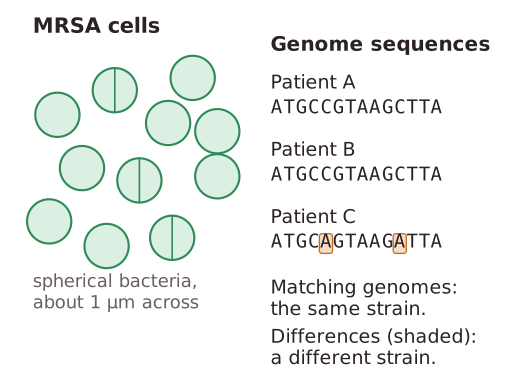
The genomes of several pathogens have been sequenced. This allows doctors to monitor the spread of diseases such as tuberculosis, identify resistant strains and identify proteins that could be useful drug targets. Sequencing pathogens from groups of people can show the pattern of transmission.Sequencing genomes can be used to identify phylogenetic relationships and how closely two species are related. In animals, cytochrome c oxidase varies between different species and the gene can be sequenced quickly and used in classification. In plants chloroplast DNA is used. This is known as barcoding. Scientists can work out the point of divergence from a putative common ancestor if they know the rate of mutation and build up theoretical evolutionary trees.
Pathogens, DNA Barcoding
Read the text
Read the text and highlight anything you think is important. When you go on, the text is hidden and you answer from memory.
Specification: OCR Biology A (H420), A-level, 6.1.3 Manipulating genomes. Topic: Genetic Engineering and Biotechnology.
Key terms in this lesson
- Chloroplast
- The organelle in plant cells that is the site of photosynthesis, containing thylakoid membranes and the stroma.
- Mutation
- A change in the base sequence of DNA.
More in Genetic Engineering and Biotechnology
- DNA Profiling
- The Polymerase Chain Reaction
- DNA Sequencing
- Automated Sequencing
- Genomics and Proteomics
- Recombinant DNA
- Genetic Engineering
- Genetically Engineering Different Organisms
All 17 lessons in Genetic Engineering and Biotechnology · All OCR A-level Biology topics