Nowadays, the sequencing reaction takes place on a plastic slide called a flow cell. PCR is carried out on DNA placed on the slide and all the fragments are sequenced at the same time in parallel. A computer is used to analyse the results and billions of base pairs can be sequenced in less than 24 hours.Bioinformatics can be used to analyse biological data including DNA sequences. Computational biology uses computational techniques to build models from the data and make predictions. DNA sequences can be analysed and the 3D structure of proteins worked out. Genes linked to certain diseases can be identified as well as phylogenetic relationships between species. Computers can analyse and compare genomes of individuals and ascertain the risks of developing certain diseases.
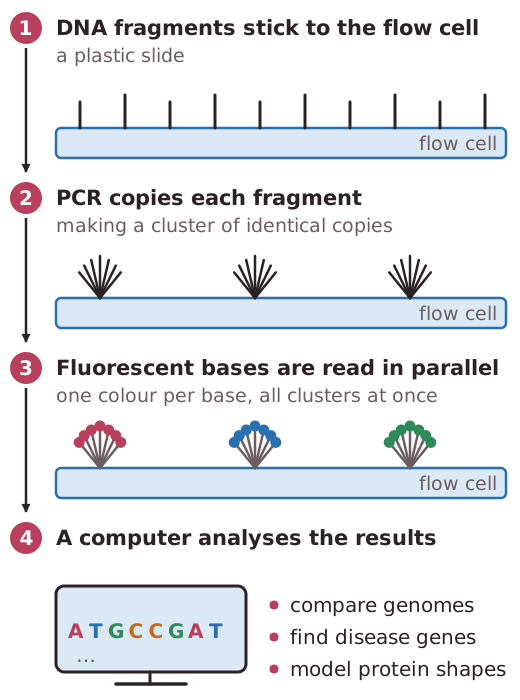
Automated Sequencing
Read the text
Read the text and highlight anything you think is important. When you go on, the text is hidden and you answer from memory.
Specification: OCR Biology A (H420), A-level, 6.1.3 Manipulating genomes. Topic: Genetic Engineering and Biotechnology.
Key terms in this lesson
- Polymerase chain reaction
- A technique for rapidly amplifying a specific sequence of DNA in vitro, using repeated cycles of denaturing, annealing of primers and DNA polymerase extension.
More in Genetic Engineering and Biotechnology
- Gel Electrophoresis
- DNA Profiling
- The Polymerase Chain Reaction
- DNA Sequencing
- Pathogens, DNA Barcoding
- Genomics and Proteomics
- Recombinant DNA
- Genetic Engineering
All 17 lessons in Genetic Engineering and Biotechnology · All OCR A-level Biology topics