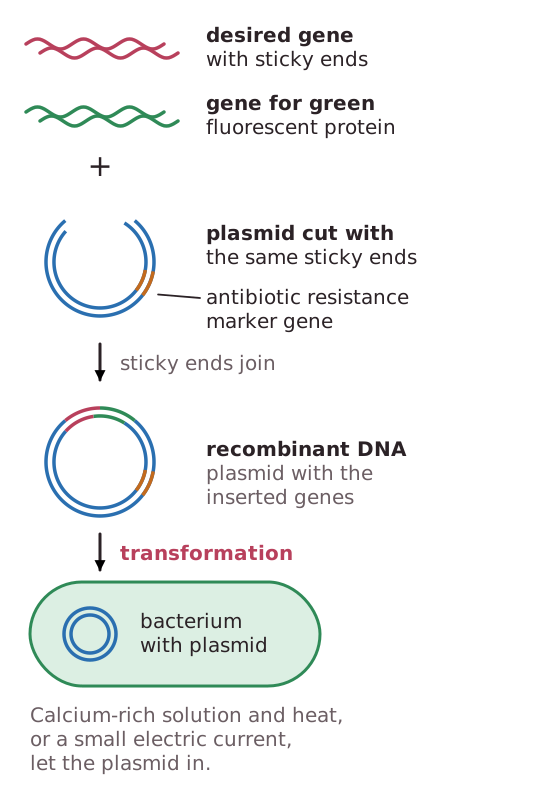
Once the gene is isolated and inserted into a vector (usually a plasmid) the vector is introduced into the host cell. Plasmids usually contain a marker gene for e.g. antibiotic resistance. A second marker gene may be placed into the plasmid such as a gene for fluorescence.The process of transferring the plasmid into the host cell is known as transformation. If E. coli are cultured in a calcium-rich solution and the temperature raised, the bacterial membrane becomes permeable to plasmids. Alternatively, a small electric current can be applied to the membrane. This is called electroporation. The nuclei of different cells can be fused together by applying tiny electrical currents to their membranes. The hybrid formed is polyploid. Electrofusion is more successful in plants.