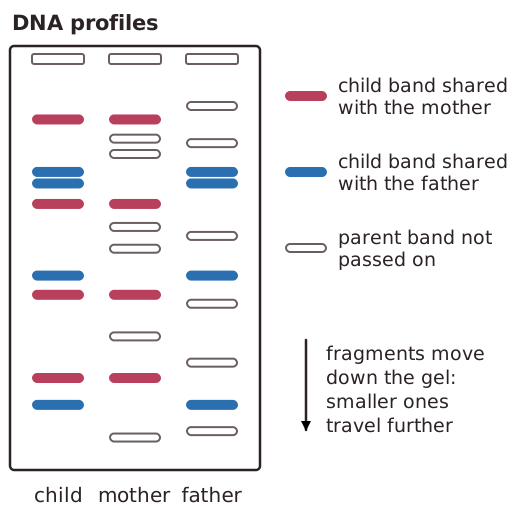
Strands of DNA are cut into small fragments using restriction endonucleases. There are thousands of different restriction enzymes each cutting DNA at a specific sequence or recognition site. A combination of restriction enzymes leaves the micro and mini-satellite regions intact.DNA fragments are then separated by gel electrophoresis. The strands are then separated into single strands and then transferred to a membrane by Southern blotting. Radioactive or fluorescent DNA probes are added. These bind to complementary strands at the correct pH and temperature (DNA hybridisation). X-ray images are taken if radioactive probes were used. U.V. is used to view the DNA if fluorescent probes were used.
DNA Profiling
Read the text
Read the text and highlight anything you think is important. When you go on, the text is hidden and you answer from memory.
Specification: OCR Biology A (H420), A-level, 6.1.3 Manipulating genomes. Topic: Genetic Engineering and Biotechnology.
Key terms in this lesson
- Gel electrophoresis
- A technique that separates fragments of DNA, or other charged molecules, according to size by passing an electric current through a gel, with smaller fragments moving further.
- Southern blotting
- A technique for transferring separated DNA fragments from an electrophoresis gel onto a nylon or nitrocellulose membrane so that they can be probed.
More in Genetic Engineering and Biotechnology
- Non-coding DNA
- Gel Electrophoresis
- The Polymerase Chain Reaction
- DNA Sequencing
- Automated Sequencing
- Pathogens, DNA Barcoding
- Genomics and Proteomics
- Recombinant DNA
All 17 lessons in Genetic Engineering and Biotechnology · All OCR A-level Biology topics