 BRAINCAKE
Recombinant DNA
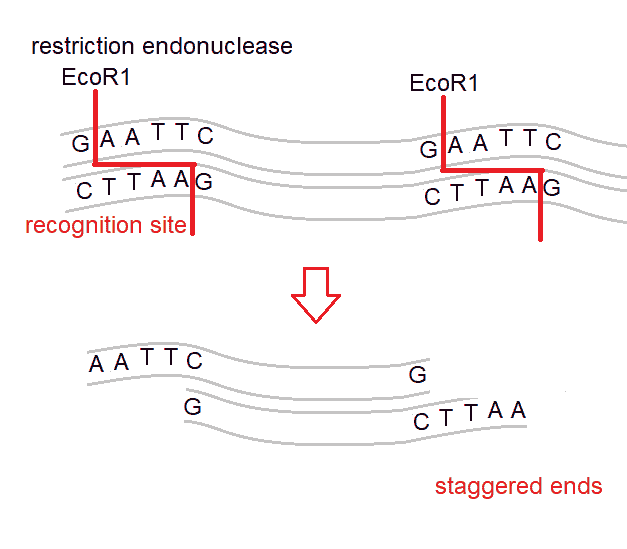
DNA from two different organisms can be joined together. First, the required gene must be isolated from the organism. It is then inserted into a vector (usually a plasmid or virus) and inserted into a host cell. Restriction endonucleases can be used to cut out the DNA from the DNA of the organism. Some restriction enzymes make blunt cuts, some make staggered cuts leaving exposed bases on each strand called sticky ends.
Sign in free to see the rest of this lesson, the R.E.C.I.P.E. recall steps and the quiz
BrainCake is free. Make an account in seconds and pick up where this page stops.
Key terms in this lesson
- Restriction endonuclease
- An enzyme that cuts DNA at a specific base sequence, or recognition site, sometimes producing single-stranded sticky ends.
More in Genetic Engineering and Biotechnology
- DNA Sequencing
- Automated Sequencing
- Pathogens, DNA Barcoding
- Genomics and Proteomics
- Genetic Engineering
- Genetically Engineering Different Organisms
- Genetically Engineering Plants
- Ethical Concerns - microorganisms
All 17 lessons in Genetic Engineering and Biotechnology · All OCR A-level Biology topics