The main photosynthetic pigment in chloroplasts is the blue-green chlorophyll a. Accessory pigments are yellow-green chlorophyll b, yellow-brown xanthophylls, orange carotenoids and phaeophytin which is a grey-brown pigment.The role of the pigments is to capture light energy by electron excitation. When light is absorbed by a pigment its electrons are excited to a higher energy level. The electrons can then take part in redox reactions transferring the light energy to other reactions. Different pigments absorb light of different wavelengths ensuring the plant absorbs as much light as possible. Chlorophylls a and b absorb red and blue light and reflect green light, so they appear green.
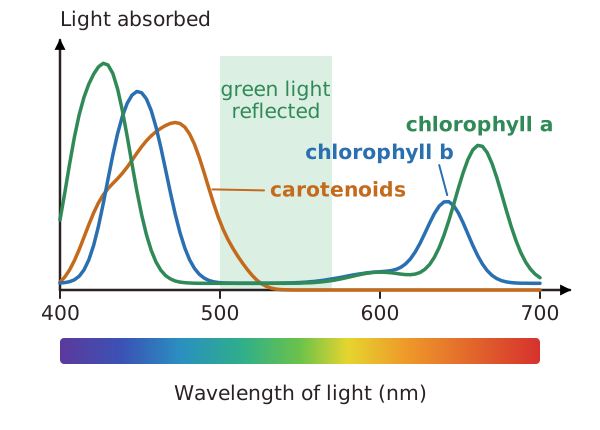
Photosynthetic pigments
Read the text
Read the text and highlight anything you think is important. When you go on, the text is hidden and you answer from memory.
Specification: OCR Biology A (H420), A-level, 5.2.1 Photosynthesis. Topic: Energy for Biological Processes.
Key terms in this lesson
- Chloroplast
- The organelle in plant cells that is the site of photosynthesis, containing thylakoid membranes and the stroma.
More in Energy for Biological Processes
- ATP
- Chloroplasts
- Photosystems
- Cyclic Photophosphorylation
- Non-cyclic Photophosphorylation
- Chemiosmosis
- Calvin Cycle
- Limiting Factors of Photosynthesis
All 17 lessons in Energy for Biological Processes · All OCR A-level Biology topics