 BRAINCAKE
ATP
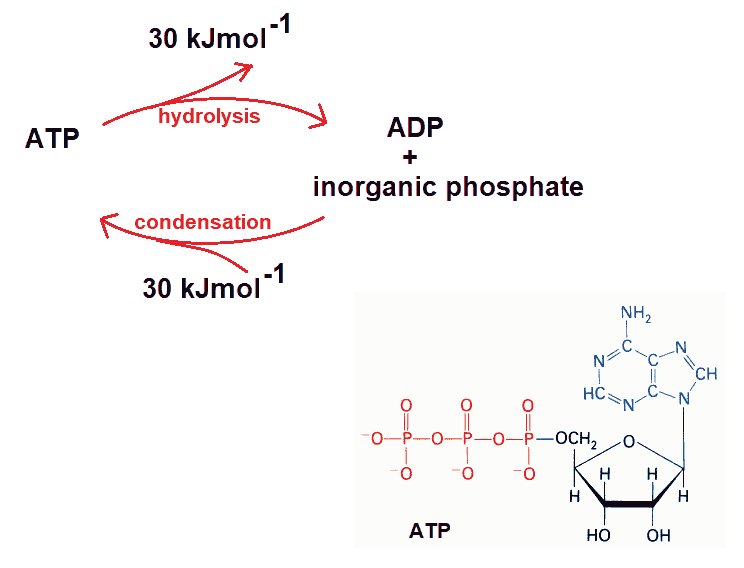
ATP is the universal energy currency in cells. It has three phosphate groups. The bonds between the three phosphate groups are unstable and have a low activation energy so can be rapidly hydrolysed. The hydrolysis reactions are energy yielding so they can be coupled with energy-requiring reactions.
Sign in free to see the rest of this lesson, the R.E.C.I.P.E. recall steps and the quiz
BrainCake is free. Make an account in seconds and pick up where this page stops.
Key terms in this lesson
- Chloroplast
- The organelle in plant cells that is the site of photosynthesis, containing thylakoid membranes and the stroma.
- Oxidative phosphorylation
- The production of ATP using the energy released as electrons pass along the electron transport chain, driving chemiosmosis in mitochondria.
More in Energy for Biological Processes
- Chloroplasts
- Photosynthetic pigments
- Photosystems
- Cyclic Photophosphorylation
- Non-cyclic Photophosphorylation
- Chemiosmosis
- Calvin Cycle
All 8 lessons in Energy for Biological Processes · All OCR A-level Biology topics