 BRAINCAKE
Non-Cyclic Photophosphorylation
Non-cyclic photophosphorylation is the main pathway of the light-dependent reactions. It uses both photosystems, and electrons flow in one direction, from water to NADP. It is often drawn as a 'Z-scheme'.
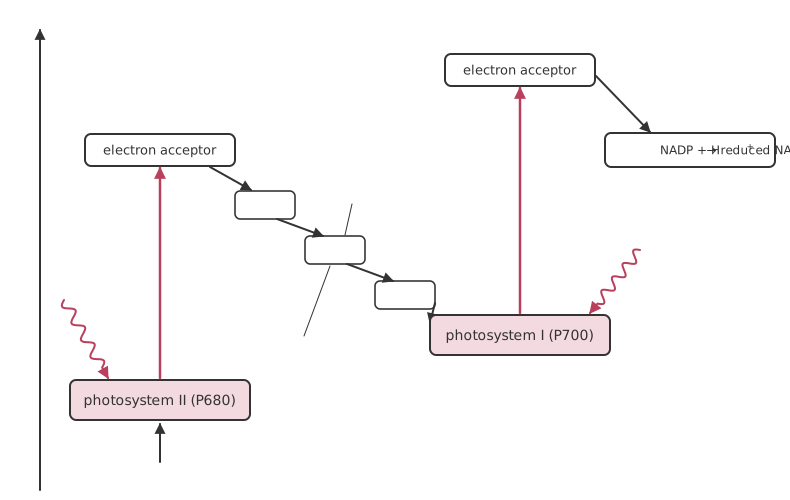
1. Light is absorbed by photosystem II. Electrons in its reaction centre are excited and pass to an electron acceptor.
2. The electrons pass along an electron transport chain to photosystem I, losing energy. The energy pumps protons into the thylakoid space, and ATP is made by chemiosmosis through ATP synthase.
Sign in free to see the rest of this lesson, the R.E.C.I.P.E. recall steps and the quiz
BrainCake is free. Make an account in seconds and pick up where this page stops.
Key terms in this lesson
- nadp
- A coenzyme that acts as a hydrogen acceptor in the light-dependent reactions of photosynthesis, becoming reduced NADP when it accepts hydrogen.
- stroma
- The fluid-filled space surrounding the thylakoids inside a chloroplast, where the light-independent reactions (Calvin cycle) take place.
More in Photosynthesis
- Chromatography
- Photosystems
- The Light-Dependent Reactions
- Cyclic Photophosphorylation
- The Light-Independent Stage
- The Calvin Cycle
- The Products of Photosynthesis
- C4 Plants
All 20 lessons in Photosynthesis · All Edexcel A-level Biology topics