In most plants, called C3 plants, the first product of carbon fixation is GP, a 3-carbon compound. RUBISCO has a drawback: at high temperatures and low CO2 concentrations it increasingly combines with oxygen instead of CO2. This process, photorespiration, wastes energy and releases fixed carbon. It is a serious problem in hot, bright conditions, where stomata close to save water and the CO2 concentration in the leaf falls.C4 plants, such as maize and sugar cane, avoid this by fixing CO2 twice, in two different cell types (Kranz anatomy).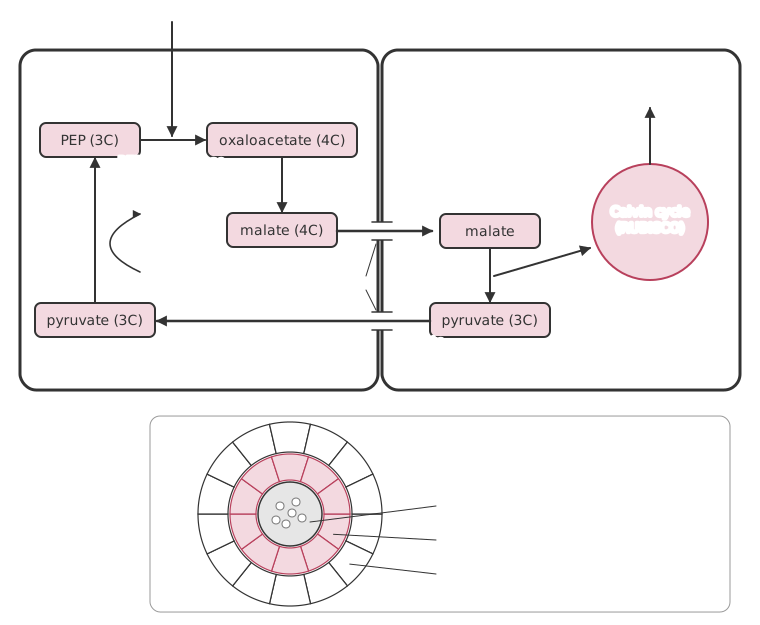
2. Oxaloacetate is converted to malate, which passes through plasmodesmata into the bundle sheath cells around the vascular bundles.
3. In the bundle sheath cells, malate releases CO2, keeping its concentration around RUBISCO very high. The Calvin cycle then runs as normal, with little photorespiration.
4. The remaining 3-carbon pyruvate returns to the mesophyll and is converted back to PEP, using ATP.This extra ATP is a cost, so C4 plants have the advantage only in hot, bright conditions, where C3 plants would lose much fixed carbon to photorespiration. In cool climates, such as the UK, most plants are C3.