Skip to content

Limiting Factors of Photosynthesis

The rate of photosynthesis depends on several external factors. The main ones are light intensity, carbon dioxide concentration and temperature. Water is also needed, but a plant usually closes its stomata and slows photosynthesis long before water runs out as a raw material.A limiting factor is the factor that is in shortest supply, so it holds the rate down. Increasing a limiting factor increases the rate; increasing any other factor has no effect. This is the law of limiting factors: at any moment the rate is set by whichever factor is nearest its minimum value.
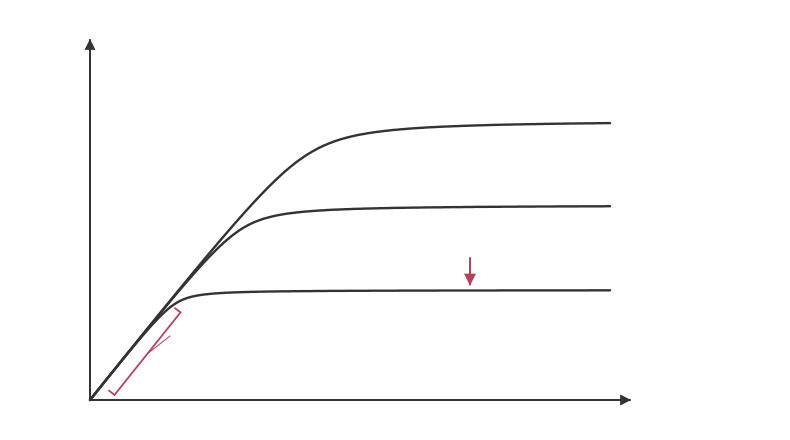
The graph shows rate of photosynthesis against light intensity. On the steep, rising part of each curve, light intensity is the limiting factor, because more light gives a faster rate. Where the curve levels off (the plateau), light is no longer limiting. Something else, such as carbon dioxide concentration or temperature, is now limiting.You can tell which factor it is by changing one factor at a time. If the plateau rises when carbon dioxide concentration is increased from 0.04% to 0.1%, carbon dioxide was the limiting factor. If, at 0.1% carbon dioxide, the plateau rises when the temperature is raised from 15 °C to 25 °C, temperature was limiting.Only one factor limits the rate at a time, but the limiting factor can change as conditions change. The next lessons look at how light, carbon dioxide and temperature each act on the reactions of photosynthesis.

Read the text

Read the text and highlight anything you think is important. When you go on, the text is hidden and you answer from memory.