The spinal cord is part of the central nervous system. It runs from the medulla oblongata down the back, inside the vertebral column, which protects it. It is also surrounded by protective membranes (the meninges) and cerebrospinal fluid.The spinal cord has two jobs: it carries impulses between the brain and the rest of the body, and it coordinates simple spinal reflexes without involving the brain.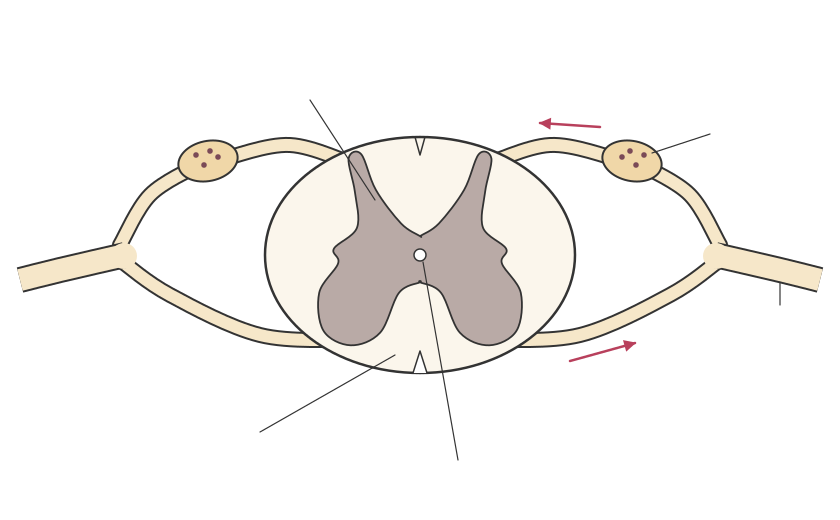
• the ventral root (towards the front) carries motor neurones out of the cord. Their cell bodies are in the grey matter.Because sensory information enters dorsally and motor instructions leave ventrally, damage to one root affects only sensation or only movement.
• the ventral root (towards the front) carries motor neurones out of the cord. Their cell bodies are in the grey matter.Because sensory information enters dorsally and motor instructions leave ventrally, damage to one root affects only sensation or only movement.