The parasympathetic nervous system is most active when the body is at rest. It controls the 'rest and digest' activities that conserve energy and build up the body's stores.Its preganglionic neurones leave the CNS from the brain (in cranial nerves) and from the sacral (lowest) region of the spinal cord. They are long and synapse in ganglia that lie close to, or inside, the effector organ, so the postganglionic neurones are short. Both the preganglionic and the postganglionic neurones release acetylcholine.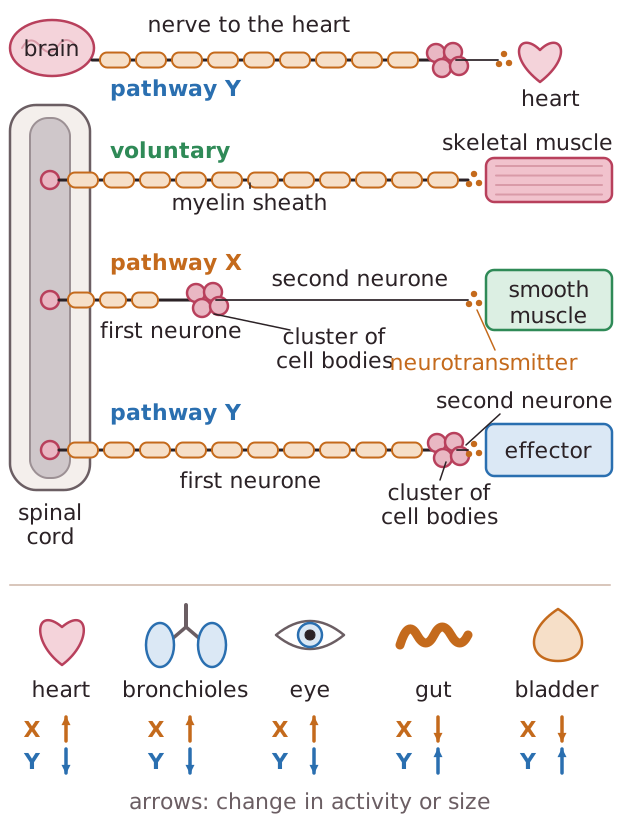 The most important parasympathetic nerve is the vagus nerve, a cranial nerve that runs from the medulla oblongata to the heart, lungs and gut.Effects of parasympathetic stimulation include:• heart rate decreases (through the vagus nerve to the sinoatrial node)
• bronchioles constrict
• pupils constrict
• more saliva and digestive juices are secreted and peristalsis speeds up
• the bladder wall contracts, helping urinationThese effects are the opposite of those of the sympathetic system, so the two are antagonistic. Most of the time both systems are active at a low level, and the effect on an organ depends on the balance between them. For example, at rest the vagus nerve constantly slows the heart: the sinoatrial node on its own would beat about 100 times per minute, but the resting heart rate is nearer 70.Comparison: the sympathetic system has short preganglionic and long postganglionic neurones and mostly releases noradrenaline; the parasympathetic system has long preganglionic and short postganglionic neurones and releases acetylcholine.
The most important parasympathetic nerve is the vagus nerve, a cranial nerve that runs from the medulla oblongata to the heart, lungs and gut.Effects of parasympathetic stimulation include:• heart rate decreases (through the vagus nerve to the sinoatrial node)• bronchioles constrict
• pupils constrict
• more saliva and digestive juices are secreted and peristalsis speeds up
• the bladder wall contracts, helping urinationThese effects are the opposite of those of the sympathetic system, so the two are antagonistic. Most of the time both systems are active at a low level, and the effect on an organ depends on the balance between them. For example, at rest the vagus nerve constantly slows the heart: the sinoatrial node on its own would beat about 100 times per minute, but the resting heart rate is nearer 70.Comparison: the sympathetic system has short preganglionic and long postganglionic neurones and mostly releases noradrenaline; the parasympathetic system has long preganglionic and short postganglionic neurones and releases acetylcholine.