Cobra venom contains toxins that act on the nervous system. The best known is α-cobratoxin, a protein that acts at neuromuscular junctions, the synapses between motor neurones and skeletal muscle fibres.At a normal neuromuscular junction, acetylcholine (ACh) released from the motor neurone binds to nicotinic acetylcholine receptors on the muscle fibre membrane. Their sodium ion channels open, the muscle membrane depolarises and the muscle fibre contracts.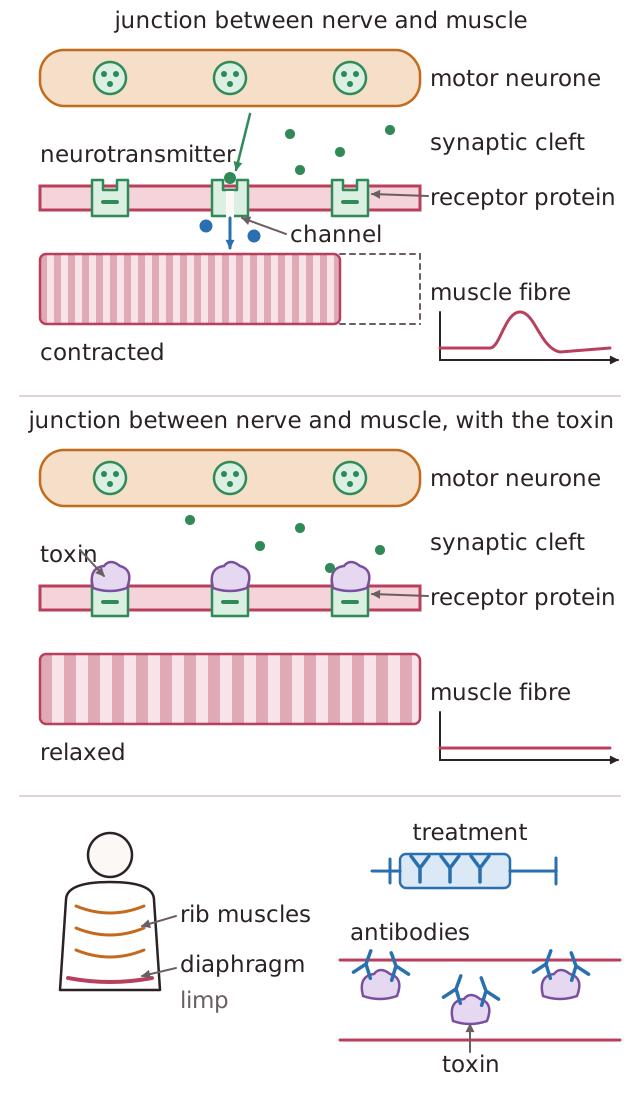 α-cobratoxin binds very tightly, almost irreversibly, to the nicotinic ACh receptors. It is an antagonist:• it occupies the ACh binding sites, so ACh cannot bind
• the ligand-gated Na+ channels do not open
• the muscle fibre membrane is not depolarised, so no action potential is generated in the muscle
• the muscle cannot contractThis causes paralysis. The most dangerous effect is paralysis of the diaphragm and intercostal muscles, which stops breathing. Without treatment, death from respiratory failure can follow.Because the toxin binds so tightly, extra ACh in the cleft cannot easily displace it. Treatment is with antivenom, which contains antibodies that bind to the toxin and neutralise it, together with artificial ventilation to keep the patient breathing until the effect wears off.Compare this with nicotine. Both bind to nicotinic ACh receptors, but nicotine is an agonist that opens the channels, while α-cobratoxin is an antagonist that blocks them. Because similar snake toxins bind so specifically, scientists have used labelled versions of them to find and count nicotinic receptors.
α-cobratoxin binds very tightly, almost irreversibly, to the nicotinic ACh receptors. It is an antagonist:• it occupies the ACh binding sites, so ACh cannot bind• the ligand-gated Na+ channels do not open
• the muscle fibre membrane is not depolarised, so no action potential is generated in the muscle
• the muscle cannot contractThis causes paralysis. The most dangerous effect is paralysis of the diaphragm and intercostal muscles, which stops breathing. Without treatment, death from respiratory failure can follow.Because the toxin binds so tightly, extra ACh in the cleft cannot easily displace it. Treatment is with antivenom, which contains antibodies that bind to the toxin and neutralise it, together with artificial ventilation to keep the patient breathing until the effect wears off.Compare this with nicotine. Both bind to nicotinic ACh receptors, but nicotine is an agonist that opens the channels, while α-cobratoxin is an antagonist that blocks them. Because similar snake toxins bind so specifically, scientists have used labelled versions of them to find and count nicotinic receptors.