Temperature affects living organisms mainly through its effect on enzymes, which control every metabolic reaction.As temperature rises, molecules have more kinetic energy, so enzyme and substrate molecules collide more often and more collisions have enough energy to react. More enzyme-substrate complexes form and the rate of reaction increases. Above the optimum temperature, vibrations break the hydrogen bonds and other bonds holding the tertiary structure together. The active site changes shape, the substrate no longer fits, and the enzyme is denatured, so the rate falls rapidly.The effect of temperature on rate is measured by the temperature coefficient, Q10:Q10 = rate at (T + 10) °C ÷ rate at T °C For most enzyme-controlled reactions between about 10 and 30 °C, Q10 is about 2, meaning the rate doubles for a 10 °C rise.Worked example: seedlings grow 4.0 mm per day at 15 °C and 9.2 mm per day at 25 °C, so Q10 = 9.2 ÷ 4.0 = 2.3.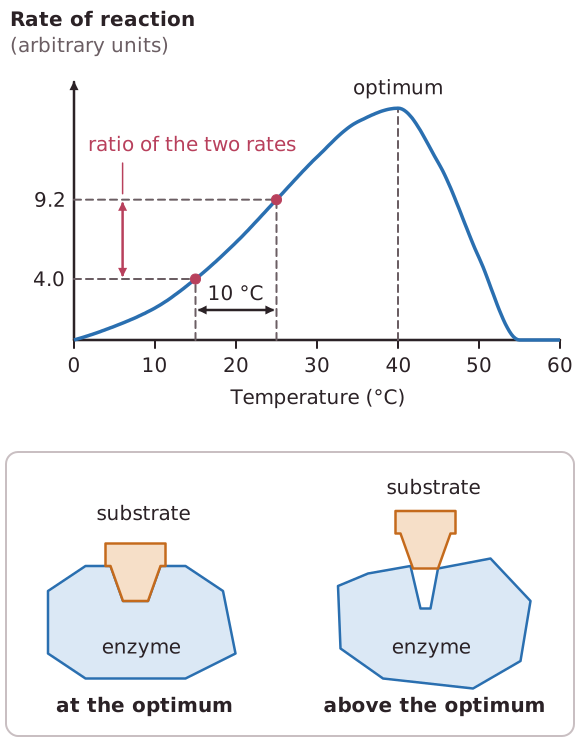 So warming affects organisms in several ways:
• ectotherms (such as insects, reptiles and plants), whose body temperature follows their surroundings, grow, develop and reproduce faster up to their optimum, so life cycles speed up and more generations may occur each year;
• above the optimum, rates fall and organisms suffer heat stress;
• in some reptiles, such as turtles, the incubation temperature of the eggs determines the sex of the offspring, so warming can skew the sex ratio;
• the timing of events such as flowering, egg-laying and migration changes.
So warming affects organisms in several ways:• ectotherms (such as insects, reptiles and plants), whose body temperature follows their surroundings, grow, develop and reproduce faster up to their optimum, so life cycles speed up and more generations may occur each year;
• above the optimum, rates fall and organisms suffer heat stress;
• in some reptiles, such as turtles, the incubation temperature of the eggs determines the sex of the offspring, so warming can skew the sex ratio;
• the timing of events such as flowering, egg-laying and migration changes.