Global warming increases the risk of flooding in two ways: rising sea levels and heavier rainfall.Sea level rise is caused by:
• thermal expansion: water expands as it warms, so a warmer ocean takes up more volume;
• melting land ice: water from glaciers and the ice sheets of Greenland and Antarctica flows into the sea.
Melting sea ice does not raise sea level directly, because floating ice already displaces its own weight of water.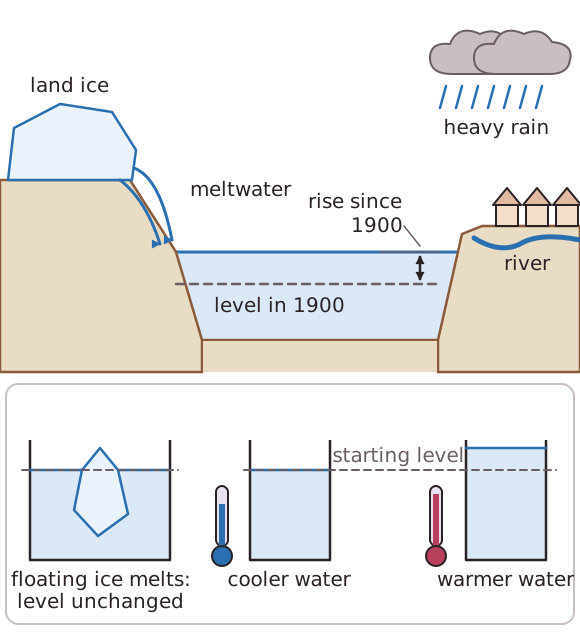 Global mean sea level has risen by about 20 cm since 1900, and the rate is increasing (now almost 4 mm per year). Models predict a further rise of about 0.3 to 1 m by 2100, depending on emissions.Heavier rainfall: warmer air holds more water vapour, so intense rainfall is more likely. River and flash flooding become more common, especially where land has been built on or deforested so that water runs off quickly.Effects on people and ecosystems:
• low-lying coasts and islands, such as Bangladesh, the Netherlands and the Maldives, are at risk, and people may be displaced;
• seawater flooding of farmland and fresh water makes soil too salty for most crops and kills freshwater organisms;
• coastal habitats such as salt marshes and mangroves may be lost if they cannot move inland;
• floodwater spreads waterborne diseases.Worked example: at 3.7 mm per year, sea level would rise by 3.7 × 80 = 296 mm (about 0.3 m) between 2020 and 2100, even if the rate did not increase.
• thermal expansion: water expands as it warms, so a warmer ocean takes up more volume;
• melting land ice: water from glaciers and the ice sheets of Greenland and Antarctica flows into the sea.
Melting sea ice does not raise sea level directly, because floating ice already displaces its own weight of water.
Global mean sea level has risen by about 20 cm since 1900, and the rate is increasing (now almost 4 mm per year). Models predict a further rise of about 0.3 to 1 m by 2100, depending on emissions.Heavier rainfall: warmer air holds more water vapour, so intense rainfall is more likely. River and flash flooding become more common, especially where land has been built on or deforested so that water runs off quickly.Effects on people and ecosystems:• low-lying coasts and islands, such as Bangladesh, the Netherlands and the Maldives, are at risk, and people may be displaced;
• seawater flooding of farmland and fresh water makes soil too salty for most crops and kills freshwater organisms;
• coastal habitats such as salt marshes and mangroves may be lost if they cannot move inland;
• floodwater spreads waterborne diseases.Worked example: at 3.7 mm per year, sea level would rise by 3.7 × 80 = 296 mm (about 0.3 m) between 2020 and 2100, even if the rate did not increase.