A climate model is a computer program that uses mathematical equations to represent the processes controlling climate: energy from the Sun, the greenhouse effect, ocean currents, clouds, ice cover and the carbon cycle. The Earth is divided into a three-dimensional grid and the model calculates how conditions in each cell change over time.Models are tested by running them over the past (hindcasting) and checking that they reproduce the measured temperature record. Models that include only natural factors (solar output and volcanic eruptions) cannot reproduce the warming since 1950, but models that also include human greenhouse gas emissions match it well. This is strong evidence that recent warming is anthropogenic.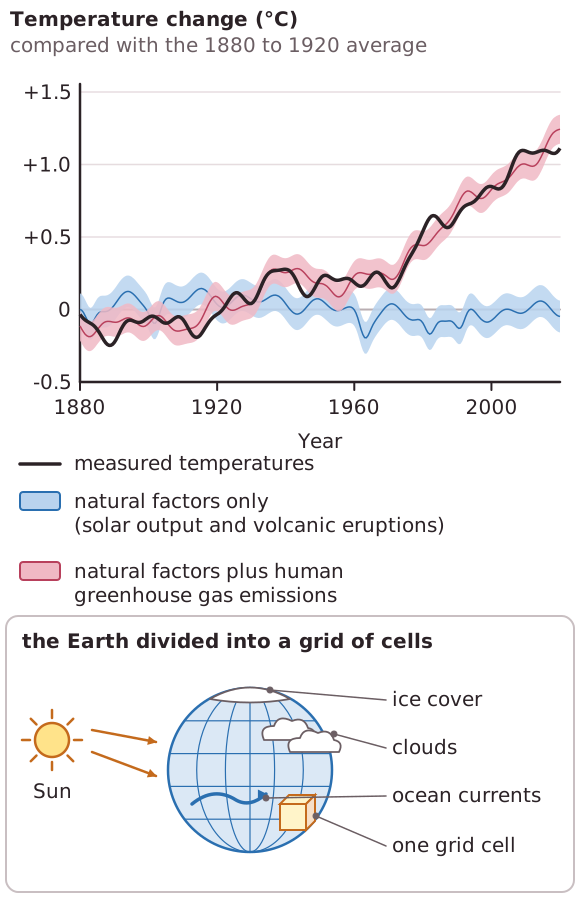 Models are then used to predict future climate. Because future emissions are unknown, they are run for different emission scenarios, from rapid cuts to continued high emissions. Predictions for 2100 range from about 1.5 °C to over 4 °C of warming above pre-industrial levels.Models have limitations:
• they rely on extrapolation beyond the range of measured data;
• some processes, such as cloud formation and ice sheet collapse, are not fully understood;
• grid cells are large, so local effects are missed;
• future population growth, human behaviour and technology cannot be known;
• the size of feedbacks, such as permafrost thaw, is uncertain.The more data a model includes and the more closely it matches past records, the more confidence we can have in its predictions. Scientists compare the results of many different models; where they agree, confidence is greater.
Models are then used to predict future climate. Because future emissions are unknown, they are run for different emission scenarios, from rapid cuts to continued high emissions. Predictions for 2100 range from about 1.5 °C to over 4 °C of warming above pre-industrial levels.Models have limitations:• they rely on extrapolation beyond the range of measured data;
• some processes, such as cloud formation and ice sheet collapse, are not fully understood;
• grid cells are large, so local effects are missed;
• future population growth, human behaviour and technology cannot be known;
• the size of feedbacks, such as permafrost thaw, is uncertain.The more data a model includes and the more closely it matches past records, the more confidence we can have in its predictions. Scientists compare the results of many different models; where they agree, confidence is greater.