Fish are a renewable resource, but only if enough adults are left to breed and replace those caught. Overfishing is catching fish faster than the population can reproduce and grow. About a third of assessed fish stocks worldwide are now overfished.Modern fleets use sonar to find shoals and very large nets, so they can remove huge numbers of fish. The Atlantic cod off Newfoundland collapsed in 1992 and has still not fully recovered.Overfishing causes several problems:
• removing large, older fish leaves young fish that have not yet bred, so fewer offspring are produced;
• bycatch: unwanted species such as dolphins, turtles and seabirds are caught and killed;
• bottom trawling damages seabed habitats;
• removing one species disrupts food webs, affecting predators such as seabirds and seals.The maximum sustainable yield (MSY) is the largest catch that can be taken each year without reducing the population in the long term. It is usually greatest when the population is at about half its carrying capacity, where the population growth rate is highest.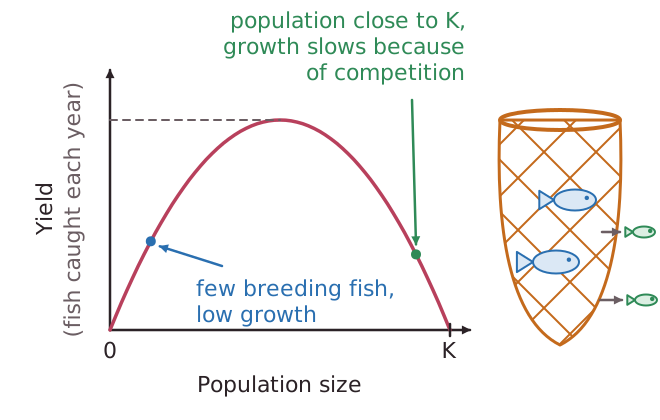 Ways to manage fish stocks:
• quotas limiting the mass of each species caught;
• minimum mesh sizes for nets, so young fish escape and can breed;
• minimum landing sizes;
• closed seasons during breeding, and no-take marine protected areas;
• limits on fishing days and fleet size.These rules are hard to enforce at sea and can cause hardship for fishing communities, and quotas can lead to fish being thrown back dead (discards).
• removing large, older fish leaves young fish that have not yet bred, so fewer offspring are produced;
• bycatch: unwanted species such as dolphins, turtles and seabirds are caught and killed;
• bottom trawling damages seabed habitats;
• removing one species disrupts food webs, affecting predators such as seabirds and seals.The maximum sustainable yield (MSY) is the largest catch that can be taken each year without reducing the population in the long term. It is usually greatest when the population is at about half its carrying capacity, where the population growth rate is highest.
Ways to manage fish stocks:• quotas limiting the mass of each species caught;
• minimum mesh sizes for nets, so young fish escape and can breed;
• minimum landing sizes;
• closed seasons during breeding, and no-take marine protected areas;
• limits on fishing days and fleet size.These rules are hard to enforce at sea and can cause hardship for fishing communities, and quotas can lead to fish being thrown back dead (discards).