 BRAINCAKE
Proximal Convoluted Tubule
The proximal convoluted tubule (PCT) is the first, coiled part of the nephron after the Bowman's capsule, in the cortex. It reabsorbs most of the filtrate: all the glucose and amino acids, and about 65% of the water and sodium ions.
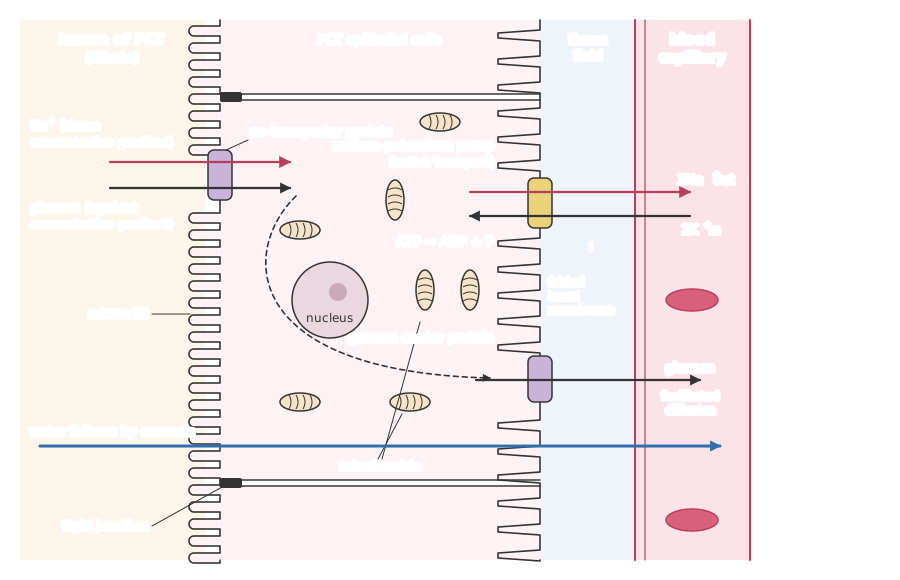
The cells of the PCT wall are adapted for reabsorption:
• microvilli on the surface facing the lumen give a large surface area
• many mitochondria provide ATP for active transport
• many carrier and co-transporter proteins in their membranes
• tight junctions between neighbouring cells, so substances pass through the cells rather than leaking between them
• a folded basal membrane next to the capillaries, giving a large surface area for transport into the blood
Sign in free to see the rest of this lesson, the R.E.C.I.P.E. recall steps and the quiz
BrainCake is free. Make an account in seconds and pick up where this page stops.
Key terms in this lesson
- bowman's capsule
- The cup-shaped end of a nephron that surrounds the glomerulus and collects the filtrate.
- facilitated diffusion
- The passive movement of a substance down its concentration gradient through a specific carrier or channel protein.
More in Homeostasis
- Osmoregulation in Mammals
- Structure and Function of the Kidney
- Ultrafiltration
- Selective Reabsorption
- Loop of Henle
- Countercurrent Multiplier
- Distal Convoluted Tubule
- Collecting Duct
All 41 lessons in Homeostasis · All Edexcel A-level Biology topics