The loop of Henle is a countercurrent multiplier. 'Countercurrent' means that the filtrate flows in opposite directions in the two limbs, which lie close together: down the descending limb and up the ascending limb. 'Multiplier' means that the small difference in concentration between the two limbs at any one level is added up along the length of the loop to build a large concentration gradient from the cortex to the inner medulla.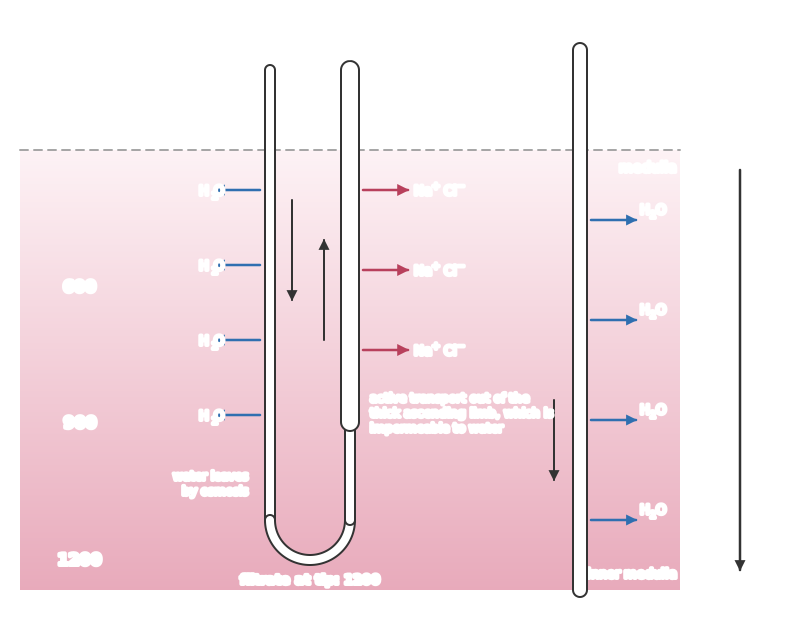
2. This lowers the water potential of the medulla next to the descending limb.
3. Water leaves the descending limb by osmosis, so the filtrate going down becomes more concentrated.
4. This more concentrated filtrate rounds the tip and enters the ascending limb, so even more ions can be removed lower down, making the deep medulla even more concentrated.At each level, the ascending limb can only make a small difference (about 200 mOsm kg−1) between itself and the tissue fluid. But because the fluid keeps flowing round the loop, the effect is multiplied. In humans, tissue fluid in the cortex is about 300 mOsm kg−1 (the same as blood), but at the tips of the longest loops it reaches about 1200 mOsm kg−1.The collecting duct runs down through this gradient, so water can leave it by osmosis along its whole length.The longer the loop of Henle, the steeper the gradient that can be built up and the more concentrated the urine that can be produced.