Gene therapy treats a genetic disorder by inserting a functional allele of a gene into a patient's cells, so they can make the missing protein. Gene editing can also be used to correct the faulty allele directly.Somatic and germ line therapy
• Somatic cell gene therapy targets body cells, such as lung or blood cells. Only the patient is affected, and the change is not inherited. Treatment may need repeating if the cells are short-lived.
• Germ line gene therapy alters eggs, sperm or early embryos, so the change would be passed to all future generations. It is not allowed in the UK.Delivering the gene
• Ex vivo: cells such as bone marrow stem cells are removed, modified in the lab and then returned to the patient.
• In vivo: the vector is put straight into the body, for example inhaled or injected into the eye.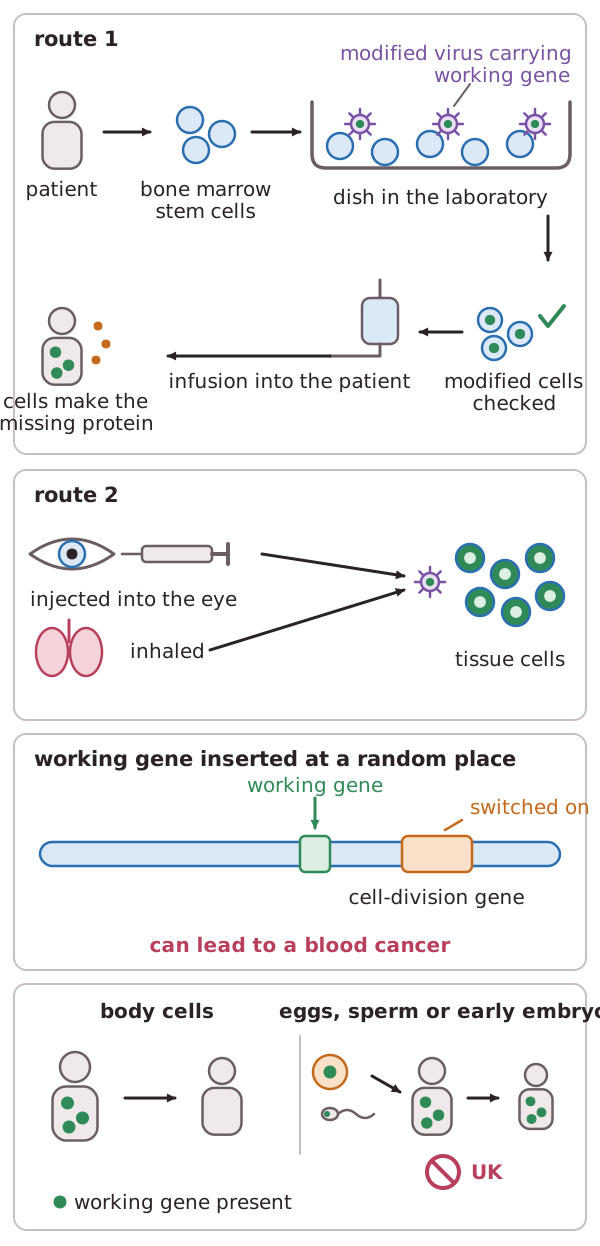 Vectors include disabled viruses (adenoviruses, adeno-associated viruses, retroviruses, lentiviruses) and liposomes.Examples
• SCID (severe combined immunodeficiency): children's bone marrow stem cells were given a working gene using a retrovirus. Many were cured, but some developed leukaemia because the viral vector inserted next to an oncogene and switched it on.
• An inherited form of blindness is treated by injecting a virus carrying the functional gene into the retina.
• Cystic fibrosis trials using liposomes gave only small, temporary improvements.Gene therapy works best for recessive disorders, because adding one working allele is enough to restore function. Dominant disorders need the faulty allele silenced or corrected.
• Somatic cell gene therapy targets body cells, such as lung or blood cells. Only the patient is affected, and the change is not inherited. Treatment may need repeating if the cells are short-lived.
• Germ line gene therapy alters eggs, sperm or early embryos, so the change would be passed to all future generations. It is not allowed in the UK.Delivering the gene
• Ex vivo: cells such as bone marrow stem cells are removed, modified in the lab and then returned to the patient.
• In vivo: the vector is put straight into the body, for example inhaled or injected into the eye.
Vectors include disabled viruses (adenoviruses, adeno-associated viruses, retroviruses, lentiviruses) and liposomes.Examples• SCID (severe combined immunodeficiency): children's bone marrow stem cells were given a working gene using a retrovirus. Many were cured, but some developed leukaemia because the viral vector inserted next to an oncogene and switched it on.
• An inherited form of blindness is treated by injecting a virus carrying the functional gene into the retina.
• Cystic fibrosis trials using liposomes gave only small, temporary improvements.Gene therapy works best for recessive disorders, because adding one working allele is enough to restore function. Dominant disorders need the faulty allele silenced or corrected.