Stabilising selection is natural selection that favours individuals with phenotypes close to the mean and selects against both extremes.It acts on characteristics that show continuous variation, which usually have a normal distribution. Individuals at either end of the range are less likely to survive and reproduce, so alleles that produce extreme phenotypes become less common, while alleles for intermediate phenotypes are kept.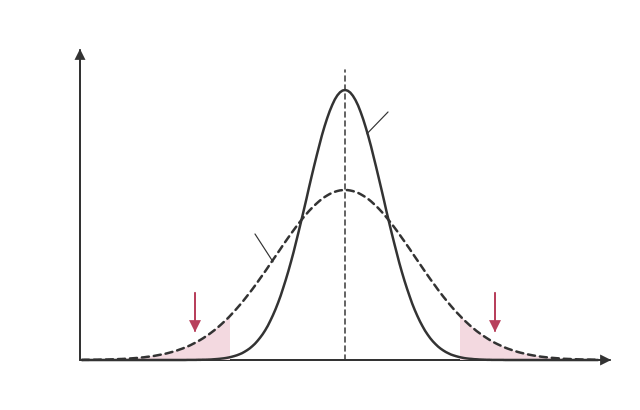
- the range of phenotypes narrows, so the standard deviation decreases;
- the distribution curve becomes taller and narrower.Stabilising selection happens when the environment is stable and the population is already well adapted to it. It is probably the most common type of selection, and it keeps populations from changing.Example: human birth mass. Babies with a very low birth mass are more likely to die, because they lose heat quickly and are less developed. Very heavy babies are more likely to have complications during birth. Babies of intermediate mass (around 3 to 4 kg) have the highest survival, so the population mean stays near this value and extremes remain rare. (Modern medical care has weakened this selection pressure in many countries.)Another example is clutch size in birds: laying too few eggs produces few offspring, but laying too many means the parents cannot feed them all, so intermediate clutch sizes are favoured.