Directional selection is natural selection that favours individuals with a phenotype at one extreme of the range.It usually happens when the environment changes, so that a phenotype that used to be rare, or at the edge of the range, now gives an advantage. Individuals with this phenotype are more likely to survive and reproduce, so the alleles responsible increase in frequency and the alleles for the other extreme decrease.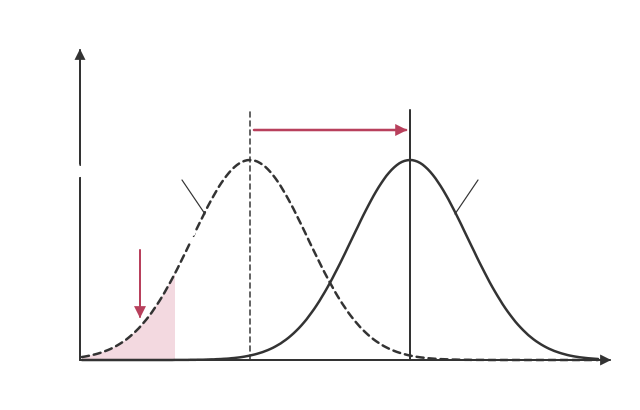
- the shape of the curve stays roughly the same while the population is changing.Example: antibiotic resistance. In a population of bacteria, a few may carry an allele that gives some resistance to an antibiotic, perhaps as a result of a mutation. When the antibiotic is used, non-resistant bacteria are killed, while resistant ones survive and divide, passing on the resistance allele. The population shifts towards high resistance. This is why antibiotics should not be overused.Example: the peppered moth. In industrial areas of 19th-century Britain, soot darkened tree bark. Dark (melanic) moths were better camouflaged from bird predators than pale moths, so the frequency of the allele for dark colour increased. When air pollution fell after the Clean Air Acts, pale moths were favoured again.Directional selection is the type of selection that produces evolutionary change in a population.
- the shape of the curve stays roughly the same while the population is changing.Example: antibiotic resistance. In a population of bacteria, a few may carry an allele that gives some resistance to an antibiotic, perhaps as a result of a mutation. When the antibiotic is used, non-resistant bacteria are killed, while resistant ones survive and divide, passing on the resistance allele. The population shifts towards high resistance. This is why antibiotics should not be overused.Example: the peppered moth. In industrial areas of 19th-century Britain, soot darkened tree bark. Dark (melanic) moths were better camouflaged from bird predators than pale moths, so the frequency of the allele for dark colour increased. When air pollution fell after the Clean Air Acts, pale moths were favoured again.Directional selection is the type of selection that produces evolutionary change in a population.