A population bottleneck is a large, sudden reduction in the size of a population, caused by an event such as a natural disaster, disease, habitat destruction or hunting.The survivors are not chosen by natural selection for their alleles: which individuals survive is largely a matter of chance. The survivors carry only a small sample of the original gene pool, so:- many alleles, especially rare ones, are lost completely;
- the allele frequencies in the survivors may be very different from those in the original population;
- genetic diversity is greatly reduced.When the population grows again, it is descended from these few survivors. Its numbers may recover, but the lost alleles do not come back (except very slowly through new mutations), so genetic diversity stays low for many generations.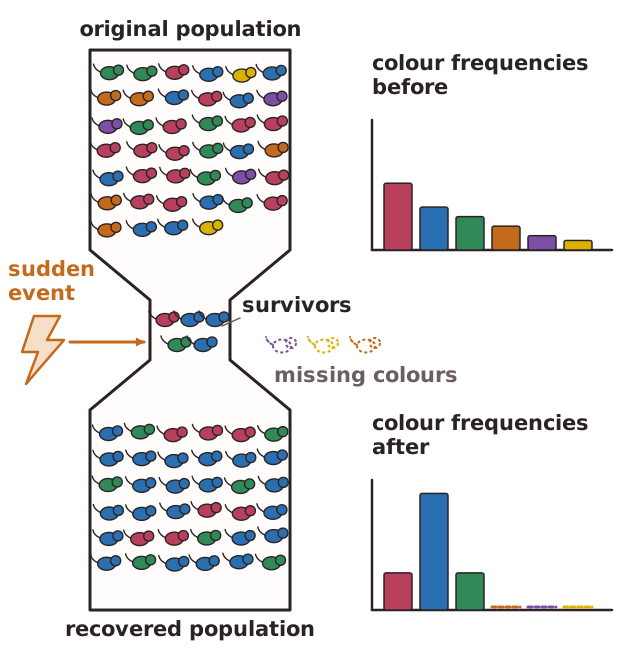 A well-known example is the northern elephant seal. Hunting in the 19th century reduced the population to fewer than 100 individuals. The population has since recovered to well over 100 000, but it has very little genetic variation. Cheetahs also have very low genetic diversity, thought to be the result of a bottleneck thousands of years ago.Low genetic diversity matters because the population has less variation for natural selection to act on. It is more vulnerable to new diseases or environmental change, and inbreeding makes harmful recessive conditions more common.
- the allele frequencies in the survivors may be very different from those in the original population;
- genetic diversity is greatly reduced.When the population grows again, it is descended from these few survivors. Its numbers may recover, but the lost alleles do not come back (except very slowly through new mutations), so genetic diversity stays low for many generations.
A well-known example is the northern elephant seal. Hunting in the 19th century reduced the population to fewer than 100 individuals. The population has since recovered to well over 100 000, but it has very little genetic variation. Cheetahs also have very low genetic diversity, thought to be the result of a bottleneck thousands of years ago.Low genetic diversity matters because the population has less variation for natural selection to act on. It is more vulnerable to new diseases or environmental change, and inbreeding makes harmful recessive conditions more common.